A moving coil galvanometer is a sensitive electromagnetic instrument used to detect and measure small direct currents (DC) in an electrical circuit. It works on the principle that a current-carrying coil placed in a magnetic field experiences a torque, causing it to rotate.
The instrument consists of a lightweight rectangular coil positioned between the poles of a permanent magnet. When current flows through the coil, the resulting electromagnetic torque produces angular deflection. A pointer attached to the moving system indicates the current on a calibrated scale.
The sensitivity and accuracy of a moving coil galvanometer depend on factors such as the number of turns in the coil, magnetic field strength, coil area, and restoring torque.
Moving coil galvanometers are commonly classified into two types: suspended coil galvanometers and pivoted coil galvanometers. They also form the basic operating mechanism of many analog DC ammeters and voltmeters.
Principle of Moving Coil Galvanometer
A moving coil galvanometer works on the principle that when a current-carrying conductor is placed in an external magnetic field, it experiences a mechanical force. In a coil, these forces produce a turning effect called torque.
The deflecting torque depends on the magnetic field strength, number of turns, area of the coil, and current flowing through it.
The deflecting torque is expressed as:
Where:
- = Deflecting torque (N·m)
- = Number of turns in the coil
- = Magnetic flux density (T)
- = Area of the coil (m²)
- = Current flowing through the coil (A)
The coil rotates until the deflecting torque is balanced by the restoring torque of the control springs.
At equilibrium:
Therefore,
Since ,, , and are constant for a given instrument:
Thus, the angular deflection of a moving coil galvanometer is directly proportional to the current flowing through its coil. This relationship produces a uniform or linear scale.
Types of Moving Coil Galvanometer
Moving coil galvanometers are broadly classified into two types based on how the coil is supported and allowed to move.
1. Suspended Coil Galvanometer
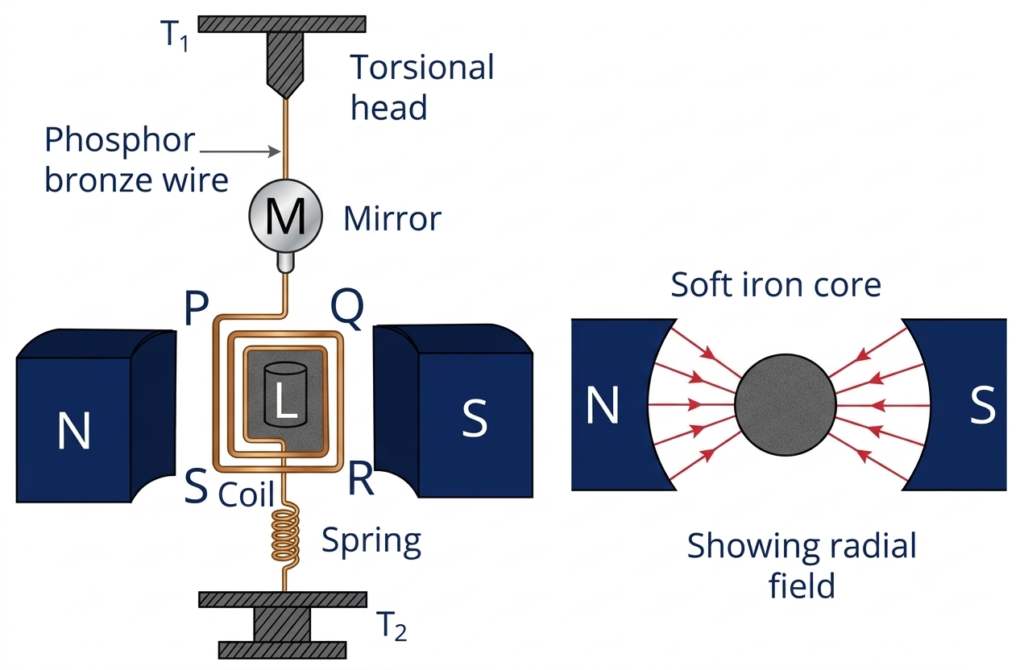
A suspended coil galvanometer uses a lightweight coil suspended by a fine metallic wire or fibre. The suspension supports the moving system and also provides the restoring torque required to bring the coil back towards its original position.
A mirror or pointer is generally attached to the moving system to indicate the deflection.
Suspended coil galvanometers are highly sensitive because the moving system experiences very little mechanical friction. They are mainly used for detecting extremely small currents in laboratory experiments.
2. Pivoted Coil Galvanometer (Weston Type)
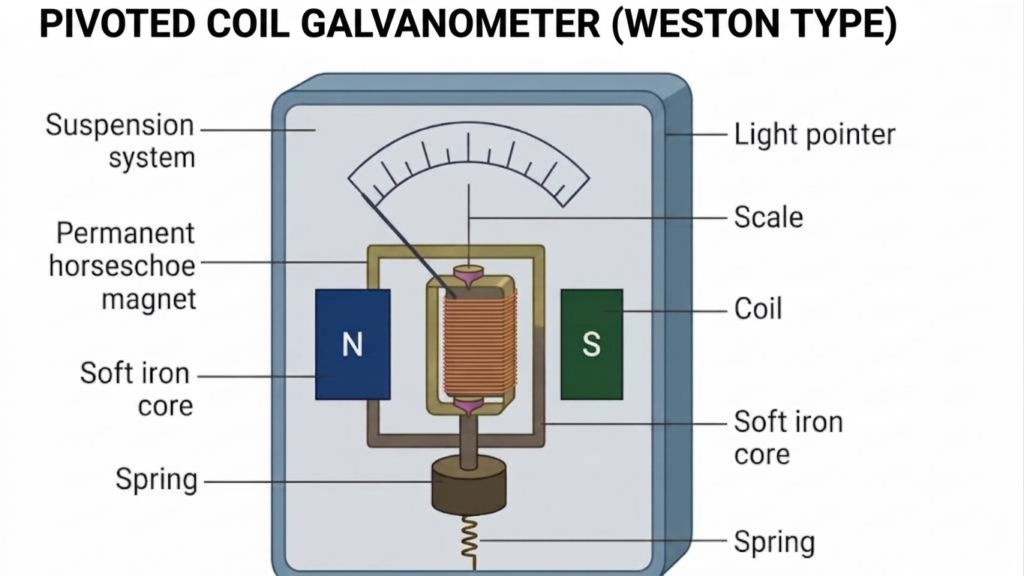
A pivoted coil galvanometer uses a coil mounted on a spindle supported by jeweled bearings or suitable pivots. The coil rotates within the magnetic field of a permanent magnet.
Spiral control springs provide the restoring torque and also carry current to the moving coil. A pointer attached to the spindle moves over a graduated scale.
The pivoted arrangement is mechanically more robust and convenient for practical measuring instruments. It is widely used in analog electrical instruments based on the permanent magnet moving coil (PMMC) mechanism.
Difference Between Suspended and Pivoted Coil Galvanometer
| Feature | Suspended coil type | Pivoted coil type |
| Coil support | Fine suspension wire or fibre | Pivots or jeweled bearings |
| Restoring torque | Suspension wire | Spiral control springs |
| Mechanical friction | Very low | Present at pivots |
| Sensitivity | Generally higher | Generally lower |
| Construction | Delicate | More robust |
| Applications | Sensitive laboratory measurements | Practical analog instruments |
Important: D’Arsonval galvanometer is another widely used name associated with the permanent-magnet moving coil design. It should not be treated as a completely independent operating principle from the moving coil galvanometer.
Construction of Moving Coil Galvanometer
The construction diagram of moving coil galvanometer is shown in the image below.
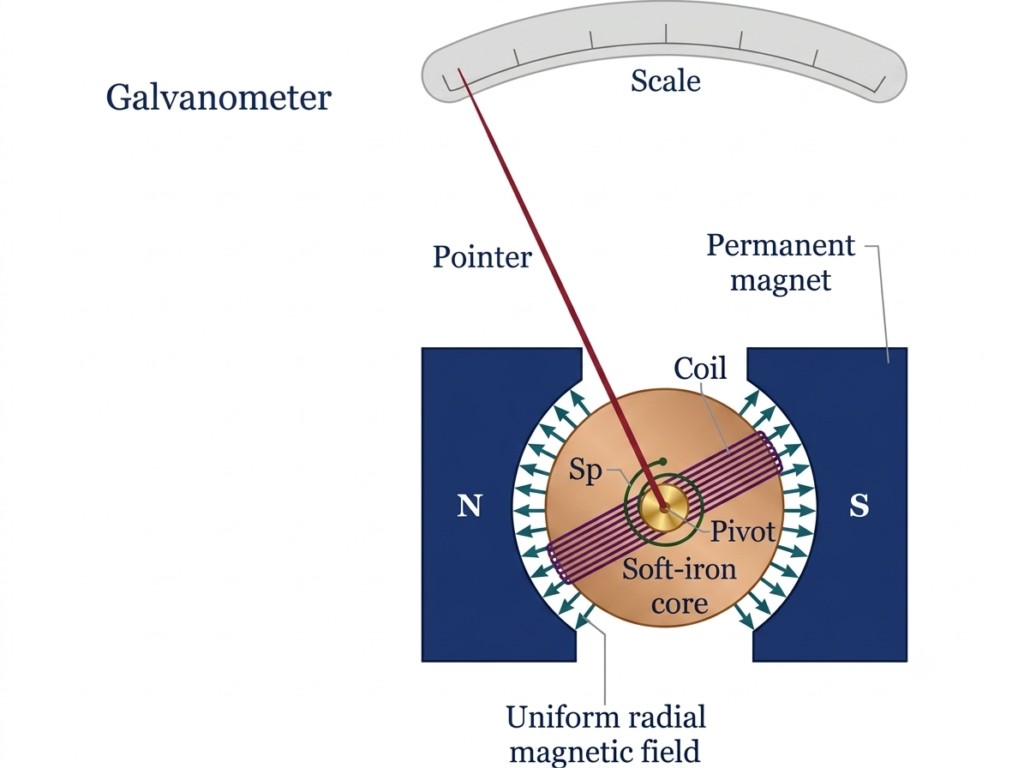
A moving coil galvanometer consists of a rectangular coil that can rotate freely in a strong, approximately radial magnetic field produced by a permanent magnet. Its construction is designed to provide high sensitivity, a uniform scale, and stable readings.
The main components are described below.
1. Permanent Magnet
A strong permanent magnet with concave pole pieces produces the magnetic field required for the operation of the galvanometer.
The specially shaped pole pieces help produce a radial magnetic field, ensuring that the magnetic torque remains proportional to the current for different angular positions of the coil.
2. Moving Coil
The moving coil consists of several turns of fine insulated copper wire wound around a lightweight rectangular frame.
It is placed between the poles of the permanent magnet. When current flows through it, electromagnetic forces produce torque and rotate the coil.
3. Soft Iron Core
A cylindrical soft iron core is positioned inside the moving coil.
It serves two important purposes:
- Increases the magnetic flux density by concentrating the magnetic field.
- Helps produce a radial magnetic field between the magnet poles.
The increased magnetic field improves the sensitivity of the galvanometer.
4. Control Springs
Two spiral springs are connected to the moving coil. They provide the restoring torque that opposes the rotation caused by electromagnetic forces.
These springs also provide electrical connections to the moving coil.
Phosphor bronze is commonly used for suspension wires and control springs because of its good electrical conductivity, elasticity, low magnetic influence, and relatively low torsional stiffness.
5. Pointer and Scale
A pointer is attached to the moving system and moves over a graduated scale to indicate the current.
In some highly sensitive arrangements, a mirror and light beam are used instead of a conventional pointer to obtain more precise readings.
6. Damping Arrangement
Damping is necessary to prevent the coil from oscillating for a long time before reaching its final position.
An aluminium former used in many moving coil galvanometers produces eddy currents during coil movement. These currents create an opposing torque that helps the moving system settle quickly.
Working of Moving Coil Galvanometer
When a DC current passes through the moving coil, the magnetic field of the permanent magnet interacts with the current flowing through the coil conductors. This interaction produces a deflecting torque, causing the coil and its attached pointer to rotate.
As the coil rotates, the control springs develop an opposing restoring torque. The coil stops moving when the deflecting torque becomes equal to the restoring torque.
At equilibrium:
Rearranging:
This equation shows that the angular deflection is directly proportional to the current flowing through the moving coil.
The proportionality constant depends on the instrument’s construction and magnetic characteristics.
Advantages of Moving Coil Galvanometer
A moving coil galvanometer offers several advantages for sensitive electrical measurements.
1. High sensitivity: It can detect very small DC currents because of its lightweight moving coil and strong magnetic field.
2. Uniform scale: The deflection is directly proportional to current, resulting in a linear scale.
3. Good accuracy: It provides reliable measurements when properly calibrated and used within its specified range.
4. Effective damping: Eddy current damping helps the pointer settle quickly without prolonged oscillations.
5. Low power consumption: Only a small amount of electrical power is required for its operation.
6. Wide measurement applications: Its basic mechanism can be adapted for use in DC ammeters and voltmeters.
Disadvantages of Moving Coil Galvanometer
Despite its advantages, a moving coil galvanometer has certain limitations.
1. DC measurement only: A conventional permanent magnet moving coil galvanometer cannot measure AC directly because the torque reverses with the alternating current.
2. Overload sensitivity: Excessive current can damage the fine coil wire, control springs, or suspension.
3. Mechanical sensitivity: Its moving components can be affected by shock, vibration, and improper handling.
4. Temperature effects: Changes in coil resistance and spring characteristics can affect measurement accuracy.
5. Higher manufacturing precision: The instrument requires careful construction, alignment, and calibration.
Limitations of Moving Coil Galvanometer
The main limitations of a moving coil galvanometer are related to its operating principle and delicate construction.
- It is primarily suitable for measuring direct current.
- Its measuring range is limited because the coil can carry only a small current.
- It requires protection against excessive current.
- Its performance may be affected by mechanical damage and temperature variations.
To measure larger currents or higher voltages, the galvanometer can be used with suitable external resistors.
Applications of Moving Coil Galvanometer
Moving coil galvanometers are used in various electrical and electronic measuring applications. Some important applications include:
1. Detection of DC current: Used to detect the presence and direction of small direct currents in electrical circuits.
2. Analog measuring instruments: Forms the basic operating mechanism of permanent magnet moving coil (PMMC) ammeters and voltmeters.
3. Laboratory experiments: Used in electrical laboratories to investigate current, resistance, and electromagnetic principles.
4. Bridge circuits: Used as a sensitive current detector in DC bridge measurement arrangements.
5. Electronic testing: Helps detect small currents in electronic circuits and experimental setups.
6. Electrical instrument development: Used as the basic mechanism for developing several analog electrical measuring instruments.
Conclusion
A moving coil galvanometer is an important electromagnetic measuring instrument used for detecting small DC currents. Its operation depends on the torque produced when a current-carrying coil is placed in a magnetic field. The radial magnetic field ensures a linear relationship between current and angular deflection, making the instrument suitable for accurate measurements.
Its sensitivity depends on the number of coil turns, magnetic field strength, coil area, and restoring torque. Due to its high sensitivity and uniform scale, the moving coil galvanometer forms the foundation of many analog DC measuring instruments, including ammeters and voltmeters.
Read Next:
- Conversion of Galvanometer into Voltmeter: Formula, Derivation and Working
- Conversion of Galvanometer into Ammeter – Formula, Circuit Diagram and Derivation
- Applications of Galvanometer
- Galvanometer: Definition, Working Principle, Construction and Working
- Sensitivity of Galvanometer: Formula, Types, Factors and Explanation
- Figure of Merit of a Galvanometer: Formula, Experiment and Calculation
- Galvanometer Resistance: Formula, Calculation and Measurement