A D’Arsonval galvanometer is a sensitive electrical measuring instrument used to detect and measure small electric currents. It works on the principle that a current-carrying coil placed in a magnetic field experiences a turning force (torque), causing the coil to rotate.
It is a type of permanent magnet moving coil (PMMC) instrument. The galvanometer uses a lightweight movable coil suspended between the poles of a permanent magnet. When current flows through the coil, it produces a deflection that indicates the magnitude and direction of the current.
The D’Arsonval galvanometer is also the basic operating mechanism used in many analog measuring instruments. By adding suitable resistors, it can be converted into an ammeter or voltmeter.
D’Arsonval Galvanometer Diagram
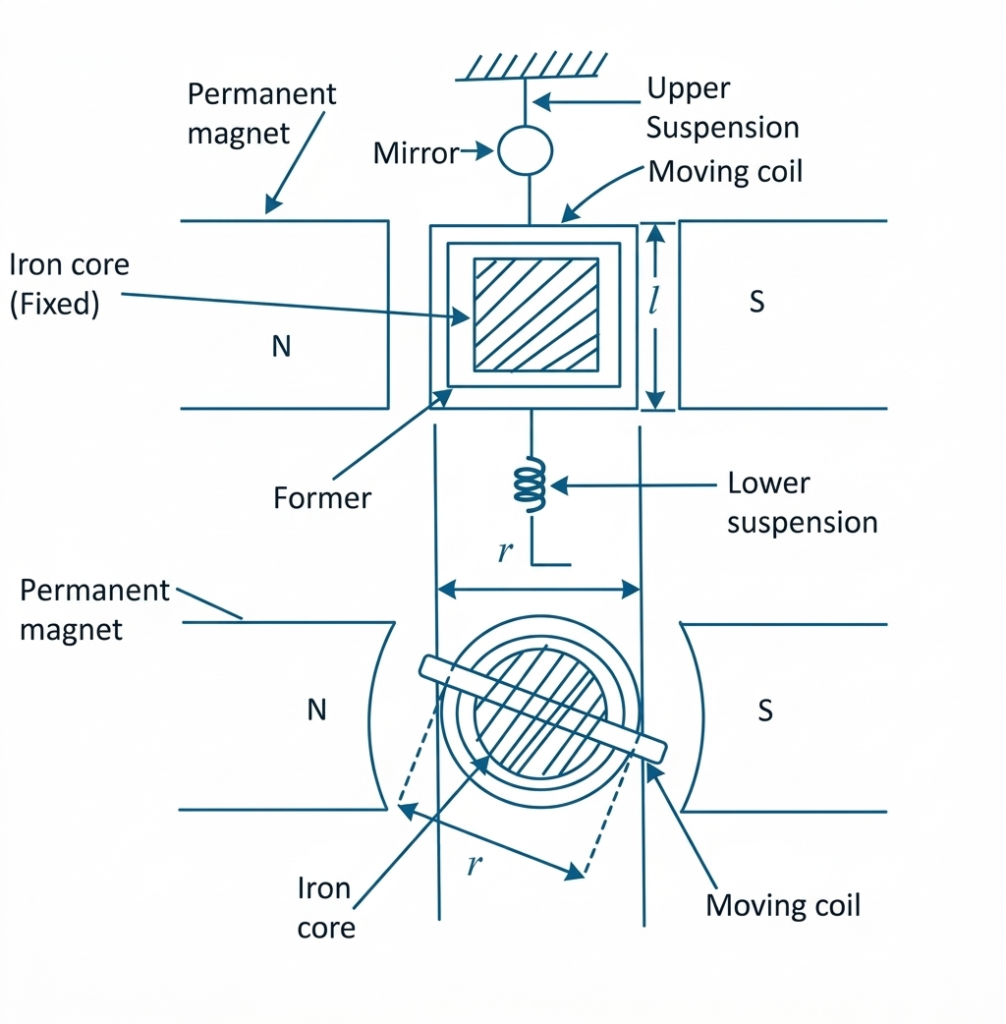
The diagram illustrates the moving coil placed between the curved pole pieces of a permanent magnet. The coil is connected to the suspension system, which provides the controlling torque and allows electrical current to pass through it.
Construction of D’Arsonval Galvanometer
The D’Arsonval galvanometer consists of a rectangular moving coil suspended in the uniform magnetic field of a permanent magnet. Its construction is designed to produce high sensitivity and a nearly uniform scale.
The main components are described below.
1. Permanent Magnet
A strong permanent magnet produces the magnetic field required for the operation of the galvanometer. Its pole pieces are generally curved or cylindrical to create a radial magnetic field in the air gap.
A soft iron cylindrical core is placed between the pole pieces. It helps concentrate the magnetic flux and produces a strong, nearly uniform radial magnetic field.
2. Moving Coil
The moving coil consists of several turns of fine insulated copper wire wound around a lightweight rectangular former.
The coil is positioned in the air gap between the permanent magnet’s pole pieces. When current passes through it, electromagnetic torque acts on the coil and causes it to rotate.
The coil former is generally made of aluminium, which also helps provide electromagnetic damping.
3. Suspension System
The coil is suspended from a thin phosphor-bronze strip or filament. This upper suspension serves two purposes:
- It mechanically supports the moving coil.
- It carries electrical current into the coil.
A flexible lower spiral spring or suspension provides the return electrical connection and contributes to the controlling torque.
The elasticity of these suspension elements determines the amount of deflection for a given current.
4. Pointer and Scale
A lightweight pointer is attached to the moving system and moves over a calibrated scale.
The pointer indicates the direction and magnitude of current flowing through the coil.
In highly sensitive galvanometers, a small mirror may be attached to the moving system instead of a conventional pointer. A reflected light beam then indicates the coil’s angular movement on a distant scale.
5. Aluminium Former
The moving coil is often wound on a non-magnetic aluminium former.
When the coil rotates, eddy currents are induced in the aluminium former. These currents produce a damping torque that opposes the movement of the coil.
This arrangement helps the pointer settle quickly at its final position without excessive oscillations.
6. Torsion Head
The upper suspension is connected to an adjustable torsion head.
It allows the operator to adjust the mechanical position of the coil and set the pointer to its zero position before taking measurements.
Working Principle of D’Arsonval Galvanometer
The D’Arsonval galvanometer works on the principle that a current-carrying conductor placed in a magnetic field experiences a mechanical force.
When a current flows through the rectangular coil placed between the poles of a permanent magnet, the two opposite sides of the coil experience forces in opposite directions. These forces form a couple that produces a deflecting torque.
As a result, the coil rotates along with the pointer.
The suspension system produces an opposing controlling torque. As the coil rotates, the controlling torque increases until it balances the deflecting torque.
At this point, the coil stops moving, and the pointer indicates the corresponding current value.
Torque Equation of D’Arsonval Galvanometer
The deflecting torque produced by a current-carrying coil in a magnetic field is:
Where:
- = Deflecting torque (N·m)
- = Number of turns in the coil
- = Magnetic flux density (Wb/m²)
- = Area of the coil (m²)
- = Current flowing through the coil (A)
The controlling torque produced by the suspension is:
Where:
- = Controlling torque
- = Torsional constant of the suspension
- = Angular deflection in radians
At the equilibrium position:
Therefore,
Rearranging:
Since , , , and remain constant for a given instrument:
This equation shows that the deflection of a D’Arsonval galvanometer is directly proportional to the current passing through its coil. Therefore, it has a uniform (linear) scale.
Damping in D’Arsonval Galvanometer
Damping is necessary to prevent the moving coil from oscillating for a long time before reaching its final position.
In a D’Arsonval galvanometer, damping is generally provided by eddy currents induced in the aluminium former.
When the coil moves through the magnetic field, the changing magnetic flux linked with the aluminium former induces circulating currents. According to Lenz’s law, these currents produce a magnetic effect that opposes the motion of the coil.
This creates a damping torque that reduces oscillations and allows the pointer to settle quickly.
The instrument can also be electrically damped by connecting a suitable low resistance across its terminals.
Proper damping helps the galvanometer reach its final reading quickly and improves measurement accuracy.
Role of the Mirror in a D’Arsonval Galvanometer
Some highly sensitive D’Arsonval galvanometers use a mirror-and-light arrangement instead of a conventional pointer.
A small mirror is attached to the moving coil. A beam of light falls on the mirror and reflects onto a scale placed at some distance from the instrument.
When current flows through the coil, the mirror rotates, causing the reflected light spot to move across the scale.
This arrangement offers two important advantages:
- High sensitivity: A very small angular movement of the coil produces a noticeable displacement of the reflected light spot.
- Reduced parallax error: Since the reading is taken from the reflected light spot, errors associated with viewing a conventional pointer from different angles are minimized.
This method is particularly useful when measuring extremely small currents.
Advantages of D’Arsonval Galvanometer
The important advantages of a D’Arsonval galvanometer include:
- High sensitivity: It can detect very small electric currents.
- Uniform scale: Its deflection is directly proportional to the current, providing a linear scale.
- Effective damping: Eddy current damping helps the pointer settle quickly.
- Good accuracy: It provides reliable measurements of small DC currents.
- Versatility: It can be converted into an ammeter or voltmeter using suitable resistors.
- Low power consumption: Only a small amount of electrical power is required to operate the moving system.
Disadvantages of D’Arsonval Galvanometer
Despite its advantages, the instrument has some limitations:
- AC measurement limitation: A conventional D’Arsonval galvanometer cannot directly measure alternating current because the torque reverses with each half-cycle, resulting in approximately zero average deflection.
- Mechanical sensitivity: Its suspension and moving coil are delicate and require careful handling.
- Temperature effects: Changes in coil resistance and suspension properties can affect measurement accuracy.
- Limited current capacity: The moving coil can carry only a small current without damage.
- Magnetic field sensitivity: External magnetic fields may affect its readings if the instrument is not adequately shielded.
Applications of D’Arsonval Galvanometer
D’Arsonval galvanometers are used in electrical and electronic measuring applications where small DC currents need to be detected or measured.
Some important applications include:
- Detecting small DC currents in electrical circuits.
- Measuring current in laboratory experiments.
- Testing and troubleshooting electronic circuits.
- Detecting current direction and polarity.
- Forming the basic measuring mechanism of analog ammeters.
- Forming the basic measuring mechanism of analog voltmeters.
- Measuring small electrical signals in instrumentation circuits.
- Use in bridge circuits and null-detection applications.
Conclusion
The D’Arsonval galvanometer is an important moving-coil instrument used for detecting and measuring small DC currents. Its operation depends on the interaction between the magnetic field of a permanent magnet and the current flowing through the movable coil.
The radial magnetic field ensures that the deflecting torque is proportional to the current, resulting in a uniform scale. Eddy current damping helps the pointer settle quickly, while the suspension system provides the necessary controlling torque.
By connecting a shunt resistance in parallel or a multiplier resistance in series, the instrument can be converted into an ammeter or voltmeter, respectively. These features make the D’Arsonval galvanometer a fundamental instrument in electrical measurement technology.
Read Next:
- Conversion of Galvanometer into Voltmeter: Formula, Derivation and Working
- Conversion of Galvanometer into Ammeter – Formula, Circuit Diagram and Derivation
- Applications of Galvanometer
- Galvanometer: Definition, Working Principle, Construction and Working
- Sensitivity of Galvanometer: Formula, Types, Factors and Explanation
- Figure of Merit of a Galvanometer: Formula, Experiment and Calculation
- Galvanometer Resistance: Formula, Calculation and Measurement
- Tangent Galvanometer: Diagram, Principle, Formula, Working and Experiment
- Types of Galvanometer: Classification and Types Explained
- Ballistic Galvanometer: Definition, Construction, Working Principle, Theory, Equation, and Calibration