A mirror galvanometer is a highly sensitive instrument used to detect and measure very small electric currents. Instead of using a conventional pointer to indicate current, it uses a small mirror to reflect a beam of light onto a distant scale. The movement of the reflected light spot indicates the magnitude and direction of the current.
The instrument can detect extremely weak electrical signals, including currents that are too small to produce a noticeable deflection in an ordinary galvanometer. For this reason, mirror galvanometers were widely used in scientific experiments, telegraph communication, and seismological recording before the development of reliable electronic amplifiers.
What Is a Mirror Galvanometer?
A mirror galvanometer is a sensitive electrical measuring instrument that detects small currents by converting the movement of a suspended magnetic system into the deflection of a reflected light beam.
It consists of a small mirror attached to a lightweight moving system. When current flows through the galvanometer coil, the magnetic interaction produces a deflecting torque. This causes the mirror to rotate.
A beam of light directed towards the mirror is reflected onto a graduated scale or screen. Even a very small rotation of the mirror produces a noticeable movement of the light spot, making it possible to detect extremely weak currents.
The reflected light beam effectively acts as a long, lightweight pointer. This arrangement improves the sensitivity of the instrument because it avoids the need for a conventional mechanical pointer.
Diagram of Mirror Galvanometer
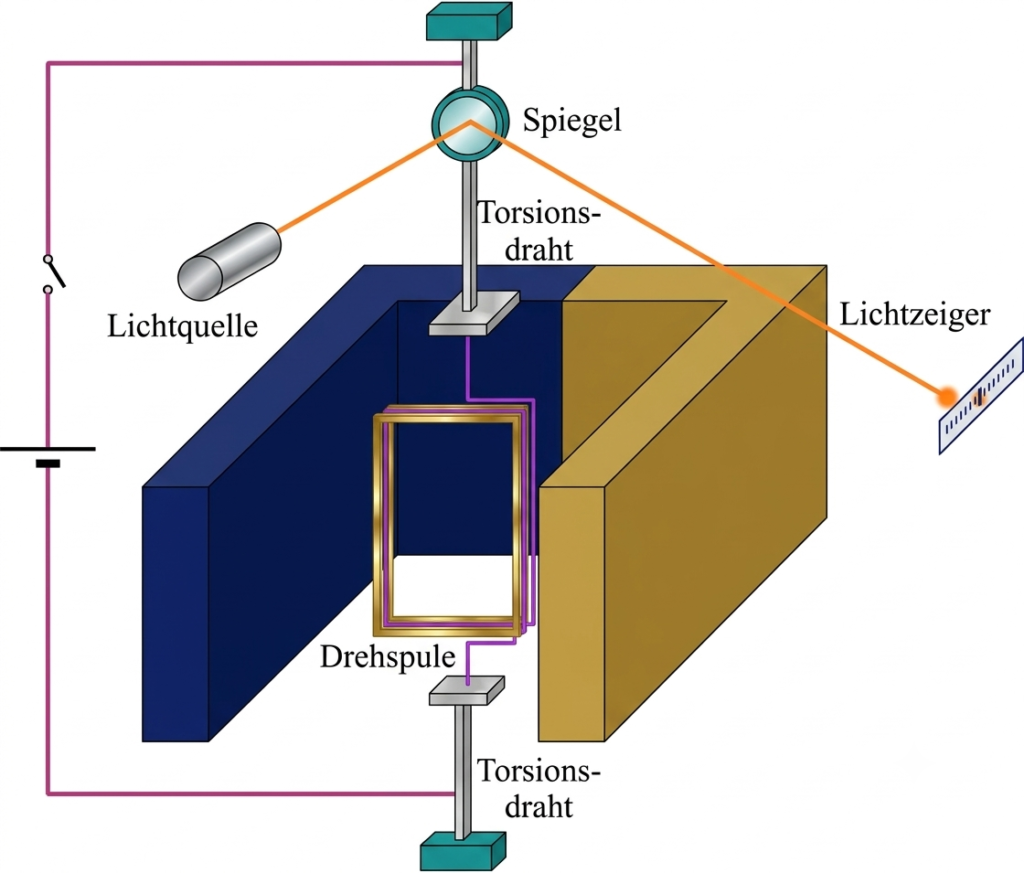
Construction of a Mirror Galvanometer
The main parts of a mirror galvanometer are:
- Galvanometer coil: A coil produces a magnetic field interaction when electric current passes through it.
- Permanent magnet: It provides the magnetic field required for the operation of the instrument.
- Small mirror: A lightweight mirror is attached to the moving magnetic system or coil. It reflects the incident light beam towards a scale.
- Suspension thread: A fine silk fibre or suspension thread supports the moving system and allows it to rotate freely.
- Light source: A lamp provides a narrow beam of light directed towards the mirror.
- Scale or screen: It receives the reflected beam and displays the movement of the light spot.
- Damping arrangement: It helps the moving system settle quickly and reduces unwanted oscillations.
The moving parts are made as light as possible to improve sensitivity. In some historical mirror galvanometers, a small magnet was attached behind the mirror and suspended in the magnetic field of a fixed coil.
Working Principle of a Mirror Galvanometer
A mirror galvanometer works on the principle that a current-carrying conductor placed in a magnetic field experiences a torque.
When electric current flows through the galvanometer coil, the magnetic interaction produces a turning effect. The coil or suspended magnetic system rotates, causing the attached mirror to change its angular position.
A beam of light reflected from the mirror moves across the scale. The displacement of the light spot indicates the current flowing through the instrument.
The basic working principle can be understood through the following steps:
- A light source is placed in front of the mirror galvanometer.
- Light from the source is directed towards the small mirror.
- The mirror reflects the light beam onto a scale or screen.
- When current flows through the galvanometer, the moving system experiences a deflecting torque.
- The mirror rotates along with the moving system.
- The reflected light spot shifts from its original position on the scale.
- The direction and amount of movement indicate the direction and relative magnitude of the current.
The greater the current, the greater the angular deflection, within the instrument’s operating range. The direction of the light spot also changes according to the direction of current.
How Does a Mirror Galvanometer Increase Sensitivity?
The high sensitivity of a mirror galvanometer comes from its optical arrangement.
In an ordinary galvanometer, a pointer is attached to the moving coil. A small current may produce only a tiny mechanical movement, which can be difficult to observe accurately.
A mirror galvanometer replaces the mechanical pointer with a reflected beam of light. The light spot moves over a scale placed at some distance from the mirror.
When the mirror rotates through a small angle, the reflected light beam rotates through approximately twice that angle. Therefore, even a very small mirror movement can produce a comparatively large displacement of the light spot.
The displacement of the light spot can be expressed as:
Where:
- = displacement of the reflected light spot
- = distance between the mirror and the scale
- = angular rotation of the mirror
For small angles, . Therefore,
This equation shows that the displacement of the light spot increases with the distance between the mirror and the scale.
Therefore, increasing the scale distance improves the optical sensitivity of the mirror galvanometer.
Mirror Galvanometer vs Ordinary Galvanometer
Both instruments detect electric current using magnetic effects. However, their methods of indicating deflection are different.
| Basis | Ordinary Galvanometer | Mirror Galvanometer |
| Main purpose | Detects small electric currents | Detects extremely small electric currents |
| Indicating system | Mechanical pointer | Reflected light spot |
| Moving arrangement | Moving coil or magnetic system | Lightweight moving system with a mirror |
| Sensitivity | Comparatively lower | Very high |
| Deflection | Pointer moves over a scale | Light spot moves over a scale |
| Measurement | Current is indicated mechanically | Current is indicated optically |
| Applications | Basic electrical measurements | Scientific experiments and weak-signal detection |
Historical Development of the Mirror Galvanometer
The mirror galvanometer became particularly important in the development of electrical communication and scientific measurement.
Its sensitivity was significantly improved by William Thomson, later known as Lord Kelvin. He developed an improved mirror galvanometer and patented the instrument in 1858.
Thomson wanted to detect extremely weak electrical signals travelling through long submarine telegraph cables. Conventional galvanometers were not sensitive enough for this purpose.
His design used a small mirror combined with a lightweight magnetised element suspended by a fine thread. The reflected light beam made very small movements visible on a distant scale.
This improvement helped engineers detect weak signals and identify defects in submarine telegraph cables. Mirror galvanometers subsequently became important instruments in telegraphy and other scientific applications.
Applications of a Mirror Galvanometer
Mirror galvanometers were widely used in applications where detecting very small electrical signals was essential.
Their important applications include:
- Telegraph communication: They were used to detect weak electrical signals transmitted through long submarine telegraph cables.
- Seismology: Mirror galvanometers were used in recording instruments associated with seismic measurements.
- Scientific experiments: They helped researchers measure very small currents in laboratory experiments.
- Electrical measurements: They were used to detect weak direct-current signals that ordinary galvanometers could not easily indicate.
- Communication systems: They were employed in early electrical communication equipment.
- Laser beam positioning: Modern galvanometer-based systems use rotating mirrors to control the direction of laser beams.
Modern Use of Galvanometer Mirrors
The term mirror galvanometer is also associated with modern galvanometer-based optical systems, commonly called galvos.
These systems use small, rapidly rotating mirrors controlled by galvanometer motors. They are used to direct laser beams accurately in applications such as laser marking, engraving, scanning, and optical positioning.
Although modern laser galvos are different from traditional current-detecting mirror galvanometers, both use controlled mirror movement to direct a light beam.
Advantages of a Mirror Galvanometer
The main advantages of a mirror galvanometer are:
- High sensitivity: It can detect extremely small electric currents.
- Optical indication: The reflected light spot acts as a lightweight pointer.
- Clear deflection: A small mirror rotation produces a noticeable movement on a distant scale.
- Direction detection: The direction of the light spot’s movement indicates the direction of current.
- Low mechanical loading: The optical arrangement avoids the need for a heavy mechanical pointer.
- Useful for weak signals: It is suitable for detecting very faint electrical signals.
Limitations of a Mirror Galvanometer
Despite its high sensitivity, a mirror galvanometer has some limitations:
- It requires a light source and a properly aligned optical arrangement.
- External vibrations can affect the suspended moving system.
- The instrument needs careful adjustment and calibration.
- The reflected light spot may be difficult to observe under unsuitable lighting conditions.
- Traditional mirror galvanometers are generally used for detecting direct-current signals rather than measuring alternating current directly.
Conclusion
A mirror galvanometer is a highly sensitive instrument designed to detect very small electric currents. It uses a lightweight mirror and a reflected beam of light instead of a conventional mechanical pointer. When current flows through the instrument, the moving system rotates the mirror, causing the light spot to shift across a scale.
Its high sensitivity made it particularly useful in early telegraph communication, seismology, and scientific experiments. Although electronic amplifiers have replaced many traditional applications, galvanometer-controlled mirrors continue to play an important role in modern laser scanning and positioning systems.
Read Next:
- Conversion of Galvanometer into Voltmeter: Formula, Derivation and Working
- Conversion of Galvanometer into Ammeter – Formula, Circuit Diagram and Derivation
- Applications of Galvanometer
- Galvanometer: Definition, Working Principle, Construction and Working
- Sensitivity of Galvanometer: Formula, Types, Factors and Explanation
- Figure of Merit of a Galvanometer: Formula, Experiment and Calculation
- Galvanometer Resistance: Formula, Calculation and Measurement
- Tangent Galvanometer: Diagram, Principle, Formula, Working and Experiment
- Types of Galvanometer: Classification and Types Explained
- D’Arsonval Galvanometer: Working Principle, Construction, Diagram and Applications
- Ballistic Galvanometer: Definition, Construction, Working Principle, Diagram, Theory, Equation, and Calibration