A tangent galvanometer is an electrical measuring instrument used to determine the magnitude of a small electric current by observing the deflection of a magnetic needle. Unlike a moving-coil galvanometer, which operates through the interaction of a current-carrying coil and a permanent magnetic field, a tangent galvanometer works on the tangent law of magnetism.
In this article, we will explain the construction, working principle, circuit arrangement, formula derivation, sensitivity, experimental procedure, and practical applications of a tangent galvanometer.
What Is a Tangent Galvanometer?
A tangent galvanometer is an instrument used to measure electric current based on the tangent law. It determines the current flowing through a circular coil by measuring the angular deflection of a magnetic needle placed at the centre of the coil.
When current passes through the coil, a magnetic field develops perpendicular to its plane. This field interacts with the horizontal component of Earth’s magnetic field, causing the compass needle to rotate through an angle.
The current is proportional to the tangent of the deflection angle, provided the instrument is correctly aligned.
Mathematically,
Where:
- I = Current flowing through the coil (A)
- K = Reduction factor of the tangent galvanometer
- θ = Angular deflection of the magnetic needle
The tangent galvanometer is mainly used in laboratory experiments involving current measurement and the determination of Earth’s magnetic field.
Diagram of Tangent Galvanometer
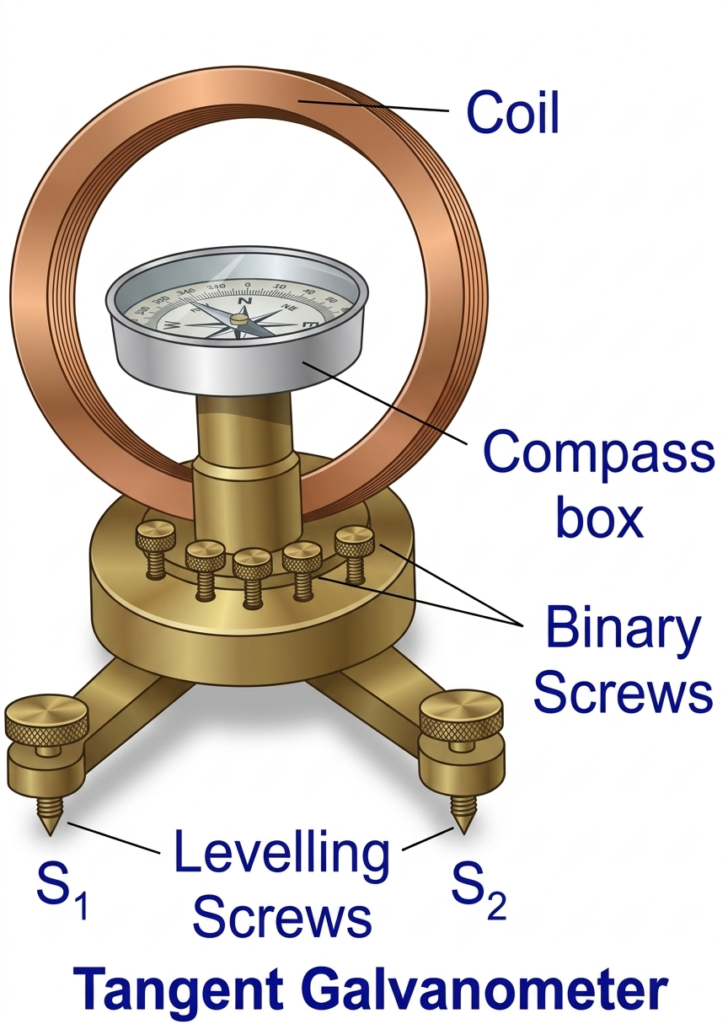
A tangent galvanometer consists of a circular vertical coil and a magnetic compass positioned at its centre. The coil is connected to an external electrical circuit through its terminals.
The compass contains a magnetic needle and a pointer that moves over a graduated circular scale. The scale helps determine the angular deflection produced when current flows through the coil.
Construction of Tangent Galvanometer
The construction of a tangent galvanometer is based on a circular coil arranged in a vertical plane. Its important parts are described below.
1. Circular Coil
The main component is a circular coil made of insulated copper wire. The wire is wound into several turns around a non-magnetic frame.
The coil is mounted vertically so that its plane can be adjusted parallel to the magnetic meridian. When current passes through it, a magnetic field is produced at the centre along the axis of the coil.
The strength of this field depends on the current, number of turns, and radius of the coil.
2. Magnetic Compass Needle
A small magnetic compass needle is placed at the centre of the circular coil. It is mounted on a pivot so that it can rotate freely in the horizontal plane.
In the absence of current, the needle aligns itself approximately along the north-south direction due to Earth’s magnetic field.
When current flows through the coil, the magnetic field produced by the coil changes the direction of the needle.
3. Graduated Circular Scale
A circular scale is provided around the compass needle to measure its angular deflection.
The scale is generally divided into four quadrants, with graduations extending from 0° to 90° in each quadrant.
4. Aluminium Pointer
A lightweight aluminium pointer is attached perpendicular to the magnetic needle. Its two ends move over the graduated scale and indicate the deflection angle.
Readings from both ends are taken to improve measurement accuracy.
5. Horizontal Base and Levelling Screws
The circular coil is mounted on a horizontal base fitted with levelling screws.
These screws help adjust the instrument so that the coil and magnetic needle remain in their correct operating positions.
6. Electrical Terminals
Two terminals are provided to connect the circular coil to an external electrical circuit.
The current supplied through these terminals generates the magnetic field required for measurement.
Working Principle of Tangent Galvanometer
The tangent galvanometer works on the tangent law of magnetism.
According to this law, when a magnetic needle is subjected to two mutually perpendicular uniform magnetic fields, it aligns itself along the direction of their resultant magnetic field.
The tangent of the angle of deflection is equal to the ratio of the magnitudes of the two magnetic fields.
Therefore,
Where:
- B = Magnetic field produced by the circular coil
- = Horizontal component of Earth’s magnetic field
- θ = Deflection of the magnetic needle
In a tangent galvanometer, the magnetic field produced by the coil acts perpendicular to Earth’s horizontal magnetic field.
When no current flows through the coil, the compass needle points in the magnetic north-south direction. When current is applied, the magnetic field of the coil causes the needle to deflect.
The needle finally settles along the direction of the resultant magnetic field. By measuring the deflection angle, the current flowing through the coil can be calculated.
Tangent Galvanometer Formula
The current flowing through a tangent galvanometer is calculated using the following formula:
Where:
- I = Current flowing through the coil (A)
- r = Mean radius of the circular coil (m)
- = Horizontal component of Earth’s magnetic field (T)
- μ₀ = Permeability of free space ()
- N = Number of turns in the coil
- θ = Angular deflection of the magnetic needle
The formula shows that the current depends on the radius and number of turns of the coil, Earth’s horizontal magnetic field, and the tangent of the deflection angle.
Reduction Factor of Tangent Galvanometer
The reduction factor is the amount of current required to produce a unit value of tangent of the deflection angle.
From the tangent galvanometer equation:
Comparing this with:
We obtain:
Where K is the reduction factor of the tangent galvanometer.
Unit: Ampere (A), since tangent of the angle is dimensionless.
The reduction factor depends on the mean radius of the coil, number of turns, and horizontal component of Earth’s magnetic field at the location.
A lower reduction factor means that a smaller current is required to produce the same tangent of deflection.
Derivation of Tangent Galvanometer Formula
Consider a circular coil having N turns and a mean radius r. Let a current I flow through the coil.
According to the Biot-Savart law, the magnetic field at the centre of a circular coil carrying current is:
Where:
- μ₀ = Permeability of free space
- N = Number of turns
- I = Current through the coil
- r = Radius of the circular coil
The magnetic field produced by the coil is perpendicular to its plane.
The tangent galvanometer is adjusted so that the plane of the coil lies in the magnetic meridian. Therefore, the magnetic field produced by the coil is perpendicular to Earth’s horizontal magnetic field.
According to the tangent law:
Substituting the magnetic field expression:
Rearranging the equation to determine current:
Therefore, the required tangent galvanometer formula is:
This equation is used to calculate an unknown current when the horizontal component of Earth’s magnetic field is known.
Working of Tangent Galvanometer
The operation of a tangent galvanometer involves the interaction between the magnetic field produced by its circular coil and Earth’s horizontal magnetic field.
The working process can be understood in the following steps:
- Initial alignment: Place the tangent galvanometer on a horizontal surface and adjust the coil so that its plane lies along the magnetic meridian. The compass needle should initially indicate zero deflection.
- Current supply: Connect the coil to a DC power supply through a suitable resistance and key.
- Magnetic field generation: When current flows through the circular coil, a magnetic field is produced at its centre. This field acts perpendicular to Earth’s horizontal magnetic field.
- Needle deflection: The magnetic needle experiences the combined effect of both fields and rotates through an angle θ.
- Reading measurement: Read the angular deflection from both ends of the pointer and calculate the mean deflection.
- Current calculation: Apply the tangent galvanometer formula to determine the current flowing through the coil.
The direction of deflection changes when the direction of current is reversed.
Experiment to Determine Earth’s Horizontal Magnetic Field Using a Tangent Galvanometer
Aim
To determine the horizontal component of Earth’s magnetic field (B_H) using a tangent galvanometer.
Apparatus Required
The following apparatus is required:
- Tangent galvanometer
- DC battery or power supply
- Ammeter
- Rheostat
- Plug key
- Reversing key
- Vernier caliper
- Connecting wires
- Spirit level
Experimental Procedure
Follow these steps to perform the experiment:
- Place the tangent galvanometer on a stable horizontal laboratory table.
- Adjust the levelling screws until the base is perfectly horizontal.
- Rotate the instrument so that the plane of the circular coil lies in the magnetic meridian.
- Adjust the compass box until the pointer reads zero-zero in the absence of current.
- Connect the battery, rheostat, ammeter, reversing key, and tangent galvanometer according to the circuit arrangement.
- Select a suitable resistance using the rheostat to limit the current.
- Close the key and allow current to flow through the circular coil.
- Observe the deflection of the magnetic needle and record readings from both ends of the pointer.
- Reverse the current using the reversing key and record the deflection again.
- Calculate the mean deflection for both current directions.
- Record the corresponding current from the ammeter.
- Repeat the observations for different current values, preferably maintaining deflections near 45°.
- Measure the inner and outer diameters of the circular coil using a vernier caliper.
- Calculate the mean diameter and mean radius of the coil.
- Calculate the horizontal component of Earth’s magnetic field using the experimental formula.
Observation Table
The following measurements are recorded during the experiment.
Number of turns of the coil (N) = ______
Inner diameter of coil (D₁) = ______ cm
Outer diameter of coil (D₂) = ______ cm
Mean diameter:
Mean radius:
Convert the radius into metres before substituting it into the SI formula.
Observation table for current and deflection:
| S. No. | Current (A) | Deflection for direct current (θ₁) | Deflection for reverse current (θ₂) | Mean deflection (θ) | tan θ |
| 1 | |||||
| 2 | |||||
| 3 | |||||
| 4 | |||||
| 5 |
Calculation
The horizontal component of Earth’s magnetic field is calculated using:
Substitute the observed values of current, number of turns, mean radius, and mean deflection.
Calculate for each observation and determine the average value.
Sensitivity of Tangent Galvanometer
Sensitivity refers to the ability of an instrument to produce a measurable change in deflection for a given change in current.
For a tangent galvanometer:
Differentiating with respect to θ:
Therefore, the angular sensitivity is:
Since:
The sensitivity depends on the deflection angle and the reduction factor.
For fractional sensitivity:
Or:
This expression reaches its maximum when:
Therefore:
A tangent galvanometer has maximum fractional sensitivity when the deflection is approximately 45°. This is why experimental readings are generally taken near this angle.
Factors Affecting the Accuracy of a Tangent Galvanometer
The accuracy of current measurement depends on several factors:
- Alignment of the coil: The plane of the coil must be accurately aligned with the magnetic meridian.
- Number of turns: The actual number of coil turns must be known correctly.
- Coil radius: Errors in measuring the mean radius affect the calculated magnetic field.
- External magnetic fields: Nearby magnets, electrical equipment, and iron objects can disturb the magnetic needle.
- Current stability: Fluctuations in current can produce inconsistent deflection readings.
- Instrument levelling: The coil and compass must be properly levelled.
- Pointer reading: Parallax errors should be avoided while measuring the deflection angle.
Advantages of Tangent Galvanometer
The important advantages include:
- It has a simple construction and operating principle.
- It provides a practical method for measuring small electric currents.
- It can be used to determine Earth’s horizontal magnetic field.
- Its operation is based on a well-established magnetic law.
- It is useful for demonstrating the relationship between electric current and magnetic fields.
Limitations of Tangent Galvanometer
Despite its usefulness in laboratory experiments, the instrument has certain limitations:
- Its readings are affected by external magnetic fields.
- Accurate alignment with the magnetic meridian is essential.
- It is not suitable for measuring rapidly changing currents.
- The accuracy of measurement depends on the precision of angular readings.
- Its sensitivity varies with the deflection angle.
- It is less convenient than modern electronic current-measuring instruments.
Applications of Tangent Galvanometer
A tangent galvanometer is mainly used in educational and experimental applications involving electricity and magnetism.
Its important applications include:
- Measurement of electric current: It can determine small currents using the deflection of a magnetic needle.
- Determination of Earth’s magnetic field: It is used to calculate the horizontal component of Earth’s magnetic field.
- Verification of tangent law: It demonstrates the relationship between two mutually perpendicular magnetic fields.
- Study of magnetic effects of electric current: It helps students understand the magnetic field produced by a current-carrying circular coil.
- Calibration experiments: It can be used in laboratory investigations involving the comparison or calibration of current-measuring instruments.
Precautions While Using a Tangent Galvanometer
The following precautions improve the reliability of experimental readings:
- Place the instrument away from magnets, iron objects, and other sources of magnetic interference.
- Ensure that the base is properly levelled before taking readings.
- Align the coil accurately along the magnetic meridian.
- Check that the compass needle reads zero before applying current.
- Use a rheostat to control the current flowing through the coil.
- Take readings from both ends of the pointer to reduce observational errors.
- Reverse the current and repeat the observations.
- Keep the current stable while taking measurements.
- Measure the coil diameter carefully using a vernier caliper.
- Avoid touching or disturbing the compass needle during the experiment.
Difference Between Tangent Galvanometer and Moving Coil Galvanometer
Although both instruments are used for current measurement, their operating principles and construction are different.
| Basis | Tangent Galvanometer | Moving Coil Galvanometer |
| Working principle | Tangent law of magnetism | Magnetic torque on a current-carrying coil |
| Magnetic field | Earth’s horizontal field and coil field | Usually a permanent magnet |
| Moving component | Magnetic compass needle | Current-carrying coil |
| Deflection relationship | Proportional to tan θ | Proportional to current under normal operating conditions |
| Main application | Current and Earth’s magnetic field measurements | Detection and measurement of small currents |
| Alignment | Requires magnetic meridian alignment | Does not require alignment with Earth’s magnetic field |
Conclusion
A tangent galvanometer is an important instrument for understanding the relationship between electric current and magnetic fields. It operates on the tangent law of magnetism, according to which the tangent of the needle’s deflection is proportional to the magnetic field produced by the circular coil.
The instrument determines current using the number of turns, coil radius, Earth’s horizontal magnetic field, and measured deflection angle. It is also useful for determining the horizontal component of Earth’s magnetic field through laboratory experiments.
Although modern electronic instruments have replaced it in many practical applications, the tangent galvanometer remains valuable for demonstrating fundamental principles of electromagnetism.
Read Next:
- Conversion of Galvanometer into Voltmeter: Formula, Derivation and Working
- Conversion of Galvanometer into Ammeter – Formula, Circuit Diagram and Derivation
- Applications of Galvanometer
- Galvanometer: Definition, Working Principle, Construction and Working
- Sensitivity of Galvanometer: Formula, Types, Factors and Explanation
- Figure of Merit of a Galvanometer: Formula, Experiment and Calculation
- Galvanometer Resistance: Formula, Calculation and Measurement
- Moving Coil Galvanometer: Principle, Construction, Working, Diagram, Formula Derivation
- Galvanometer Constant: Formula, Derivation, Definition and Significance
- Galvanometer and Direction of Current
- Galvanometer Half Deflection Method: Formula, Experiment and Calculation