An energy meter is an essential electrical measuring instrument used to determine how much electrical energy a consumer uses over a specific period. It plays a vital role in electricity billing, energy monitoring, power management, and reducing unnecessary energy consumption in residential, commercial, and industrial installations.
Different types of energy meters are available to meet different measurement requirements. Traditional electromechanical meters use a rotating disc, whereas modern electronic meters measure electrical parameters using sensors and electronic circuits. Smart energy meters go a step further by enabling remote reading, communication, and advanced energy monitoring.
In this guide, you will learn what an energy meter is, its working principle, the major types of energy meters, their characteristics, advantages, disadvantages, and applications.
What Is an Energy Meter?
An energy meter is an electrical instrument that measures the electrical energy consumed by a load over time. The measured energy is generally expressed in kilowatt-hours (kWh), commonly called units of electricity.
One kilowatt-hour represents the energy consumed by a 1 kW electrical load operating continuously for one hour.
For example, if a 2 kW heater operates for 3 hours, its energy consumption is:
Energy consumed = Power × Time
Energy consumed = 2 kW × 3 h = 6 kWh
Therefore, the heater consumes 6 units of electrical energy, assuming it operates at its rated power throughout the period.
Energy meters are installed in homes, offices, shopping complexes, manufacturing plants, and other facilities to record electricity consumption. Electricity distribution companies use meter readings to calculate bills, while industries use them to monitor energy usage and improve electrical efficiency.
Working Principle of an Energy Meter
The working principle of an energy meter depends on its design. Electromechanical induction meters operate through electromagnetic induction, while electronic and digital meters use voltage and current sensing circuits to calculate electrical energy.
For an AC electrical supply, the instantaneous active power is determined by multiplying the instantaneous voltage and current. The meter integrates this power over time to calculate the energy consumed.
For a sinusoidal AC supply, the active power can be expressed as:
P = V × I × cos φ
Where:
- P = Active power in watts (W)
- V = RMS supply voltage in volts (V)
- I = RMS current in amperes (A)
- cos φ = Power factor
Electrical energy is calculated by integrating active power over time. For a constant load, the calculation simplifies to:
E = P × t
Where:
- E = Electrical energy
- P = Active power
- t = Operating time
1. Current Measurement
The energy meter measures the current drawn by the connected load. In a direct-connected meter, the load current passes through the meter’s current circuit.
In electronic meters, a current sensor or measuring element detects the current flowing through the circuit. Depending on the design and current rating, a current transformer or another suitable sensor may be used.
2. Voltage Measurement
The meter also measures the supply voltage applied to the load. An internal voltage circuit scales the voltage to a suitable level for measurement.
The voltage and current measurements are processed together to determine the active power consumed by the connected equipment.
3. Calculation of Electrical Energy
The meter continuously calculates power and accumulates the energy consumed over time. The result is recorded in kilowatt-hours.
In a traditional induction energy meter, the interaction between the magnetic fluxes produced by the current and voltage coils generates torque on an aluminium disc. The disc rotates at a speed related to the power consumed, and a counting mechanism records the accumulated energy.
In an electronic energy meter, measurement circuits and a microcontroller or dedicated metering integrated circuit perform the calculations and display the energy reading.
Construction of Energy Meter
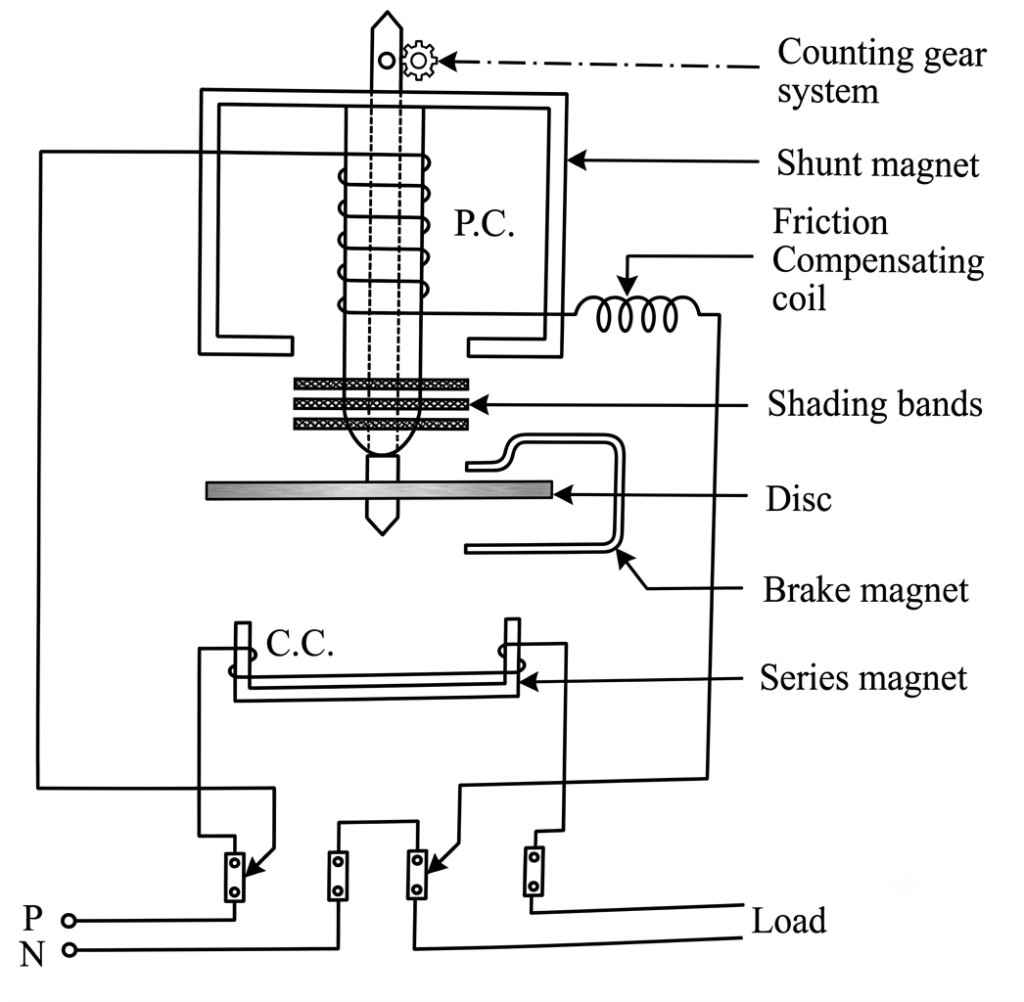
A energy meter is an electromechanical instrument used to measure the electrical energy consumed by a load connected to a single-phase AC supply. Its construction is similar to that of a single-phase induction motor, but it is designed to measure accumulated energy rather than produce continuous mechanical power.
The main components of a single-phase induction energy meter are:
- Driving system
- Moving system
- Braking system
- Registering system
1. Driving System
The driving system produces the torque required to rotate the aluminium disc. It consists of two electromagnets: a series magnet and a shunt magnet.
Series Magnet (Current Coil)
The series magnet consists of a laminated silicon-steel core with a few turns of thick copper wire wound around it. The coil is connected in series with the load, so it carries the load current. For this reason, it is also known as the current coil (CC).
The current coil produces a magnetic flux that is approximately proportional to the load current. This flux interacts with the flux produced by the shunt magnet to generate the driving torque responsible for rotating the disc.
Shunt Magnet (Voltage Coil)
The shunt magnet consists of a laminated silicon-steel core designed to provide a high magnetic reluctance path. A large number of turns of fine copper wire are wound around its central limb. This coil is connected across the supply and is therefore called the voltage coil or potential coil (PC).
The shunt magnet produces a magnetic flux approximately proportional to the supply voltage. To obtain the correct driving torque, the shunt flux must lag the supply voltage by approximately 90 degrees.
This phase displacement is achieved by adjusting the shading bands fitted to the shunt magnet. These bands influence the magnetic flux and help establish the required phase relationship.
A friction-compensation arrangement may also be provided to improve the meter’s performance at low loads by compensating for small frictional effects in the moving system.
2. Moving System
The moving system consists mainly of a thin, lightweight aluminium disc mounted on a spindle. The disc is positioned in the air gap between the series and shunt magnets.
Alternating magnetic fluxes from the two electromagnets induce eddy currents in the aluminium disc. The interaction between these fluxes and the induced currents produces a driving torque, causing the disc to rotate.
The driving torque is approximately proportional to the active power consumed by the load under the meter’s normal operating conditions.
Unlike many indicating instruments, a traditional induction energy meter does not use a conventional controlling spring to establish a final pointer position. Instead, the disc rotates continuously while energy is being consumed, and its total revolutions are counted by the registering mechanism.
3. Braking System
The braking system consists of a permanent magnet positioned near the edge of the aluminium disc. It is commonly called the braking magnet.
As the disc rotates through the magnetic field of this permanent magnet, eddy currents are induced in the disc. Their interaction with the braking magnet’s field produces a torque that opposes the disc’s rotation.
The braking torque increases with disc speed and helps establish a steady relationship between the disc’s rotational speed and the power consumed.
The braking force can be adjusted by changing the position of the permanent magnet:
- Moving the magnet towards the centre: The braking effect generally decreases, allowing the disc to rotate faster.
- Moving the magnet towards the outer edge: The braking effect generally increases, reducing the disc speed.
Proper adjustment of the braking magnet is important for obtaining accurate energy measurements.
4. Registering System
The registering system records the total number of revolutions made by the aluminium disc and converts them into an electrical energy reading.
A gear train connected to the disc spindle drives a series of numbered dials or a mechanical counter. In traditional pointer-type registers, several pointers move over calibrated scales, with each dial representing a decimal position. The readings must be interpreted in the correct order.
Another arrangement uses a cyclometer register, which displays the reading through rotating numbered drums rather than pointers.
The registering mechanism is calibrated so that the accumulated disc revolutions correspond to the electrical energy consumed, typically expressed in kilowatt-hours (kWh).
Types of Energy Meters
Energy meters can be classified according to the supply system, measurement technology, communication capability, and billing arrangement. The following are the major types used in electrical installations.
1. Single-Phase Energy Meter
A single-phase energy meter measures electrical energy in a single-phase AC supply system. It is commonly installed in residential buildings, small offices, shops, and other installations with relatively low power requirements.
A typical single-phase, two-wire meter has connections for the phase and neutral conductors. The meter measures the electrical energy consumed by connected loads such as lighting, fans, refrigerators, televisions, and other household appliances.
Single-phase meters are available in electromechanical and electronic designs. Modern versions generally provide a digital display for easy reading.
Applications:
- Residential electricity metering
- Small commercial establishments
- Domestic electrical appliances
- Single-phase workshops and offices
2. Three-Phase Energy Meter
A three-phase energy meter measures energy consumption in three-phase electrical systems. It is widely used in factories, commercial buildings, pumping stations, large offices, and industrial installations.
These meters are designed to measure energy supplied through a three-phase, three-wire or three-phase, four-wire system, depending on the installation.
For high-current applications, the meter may be connected through current transformers (CTs). Voltage transformers may also be used where the system voltage requires them. CT-operated metering requires the correct transformer ratios and meter configuration to obtain accurate readings.
Three-phase energy meters can measure the combined energy consumption of three phases, including loads connected to different phases.
Applications:
- Industrial plants and manufacturing facilities
- Commercial complexes
- Three-phase motors and pumps
- HVAC systems
- Large electrical distribution systems
3. Electromechanical Energy Meter
An electromechanical energy meter, also known as an induction-type energy meter, is a traditional electricity meter that uses electromagnetic induction to measure energy consumption.
Its main components include a current coil, a voltage coil, an aluminium disc, a permanent braking magnet, and a mechanical counting mechanism.
The current and voltage coils produce magnetic fluxes that interact to generate driving torque on the aluminium disc. The disc rotates as electrical energy is consumed. A permanent magnet provides braking torque, helping establish a relationship between disc rotation and energy consumption.
A mechanical register counts the disc rotations and displays the accumulated energy.
Advantages:
- Simple operating mechanism
- Long service life when properly maintained
- No electronic display or communication system is required
Limitations:
- Moving parts can wear over time
- Remote monitoring is generally unavailable
- Reading and data collection may require manual inspection
- Accuracy can be affected by mechanical wear and operating conditions
4. Digital Energy Meter
A digital energy meter measures electrical energy using electronic measuring circuits and displays the result numerically on an LCD or LED screen.
Voltage and current signals are sensed and processed electronically. The meter calculates the consumed energy and stores the accumulated reading in its internal memory.
Many digital meters can display additional parameters, such as voltage, current, power factor, frequency, and maximum demand, depending on their features.
Unlike an electromechanical meter, a digital meter does not require a rotating aluminium disc or mechanical counting register.
Advantages:
- Easy-to-read numerical display
- High measurement accuracy when properly specified and calibrated
- Compact construction
- Availability of additional electrical parameters
- Potential for electronic data storage and communication
Applications:
- Residential and commercial buildings
- Electrical panels
- Industrial energy monitoring
- Sub-metering of individual loads
5. Electronic Energy Meter
An electronic energy meter uses semiconductor-based measuring circuits to determine the electrical energy consumed by a load. It converts measured voltage and current signals into digital information and calculates the accumulated energy.
Electronic meters may use a dedicated metering IC, a microcontroller, or a digital signal-processing circuit. Depending on their design, they can measure active energy, reactive energy, apparent power, demand, and other electrical quantities.
Digital energy meters are generally a type of electronic energy meter. The term digital commonly describes the way measurements are processed or displayed, while electronic refers to the technology used for measurement.
Applications:
- Modern electricity metering
- Commercial and industrial distribution boards
- Energy audits
- Power consumption analysis
- Advanced metering systems
6. Smart Energy Meter
A smart energy meter is an electronic meter equipped with communication capabilities that allow readings and other information to be exchanged with a utility or monitoring system.
Depending on the communication technology, a smart meter may transmit data through cellular networks, radio frequency, power-line communication, or other supported communication systems.
Smart meters can reduce the need for manual meter reading and help utilities improve billing operations, consumption analysis, and outage management. Some systems also support remote configuration and connection or disconnection functions, subject to the meter design and applicable regulations.
Key features:
- Remote meter reading
- Consumption data recording
- Two-way communication in supported systems
- Improved monitoring of electricity usage
- Support for time-based tariffs where enabled
Smart meters require appropriate communication infrastructure and data-management systems to deliver their full benefits.
7. Prepaid Energy Meter
A prepaid energy meter allows consumers to pay for electricity in advance. The consumer purchases an energy credit, which is associated with the meter through a supported recharge or payment system.
As electricity is consumed, the available credit decreases. The meter may provide a low-credit warning and follow the configured supply-disconnection procedure when the available credit is exhausted.
Prepaid meters can be electronic or smart meters, depending on their construction and communication capabilities.
Applications:
- Rental properties
- Hostels and residential complexes
- Commercial premises
- Installations requiring consumption-based payment control
8. Time-of-Use Energy Meter
A time-of-use (ToU) energy meter records electricity consumption across different time periods. The associated tariff may charge different rates during peak, off-peak, or other designated hours.
For example, electricity consumed during periods of high demand may have a higher tariff than electricity consumed during designated off-peak hours. This arrangement can encourage consumers to shift flexible loads to lower-cost periods.
Modern electronic meters can maintain separate energy registers for different tariff periods and switch between them according to a programmed schedule.
A separate physical meter for each time period is generally not necessary. One suitably configured meter can record consumption for multiple tariff registers.
Applications:
- Industrial facilities with time-based tariffs
- Commercial buildings
- Large electricity consumers
- Demand-side energy management
9. CT-Operated Energy Meter
A current-transformer-operated energy meter is used when the load current exceeds the direct-current rating of the meter or when the installation design requires current transformers.
A CT reduces the primary current to a standard secondary value suitable for the metering circuit. For example, a 400/5 A current transformer produces a nominal secondary current of 5 A when the primary current is 400 A, under rated conditions.
The meter must be compatible with the CT secondary rating and configured with the correct CT ratio. The measured energy may need to be multiplied by the appropriate transformation factor if the meter does not apply it internally.
Applications:
- Industrial switchboards
- High-current distribution systems
- Large commercial installations
- Electrical energy audits
CT secondary circuits must be installed and handled according to safety procedures. An energized CT secondary must not be left open-circuited.
10. Net Energy Meter
A net energy meter is used in installations where electricity can flow both from the utility supply to the consumer and from the consumer’s generation system back to the grid.
A common example is a building with a grid-connected solar photovoltaic system. The meter records imported and exported energy according to the applicable metering arrangement.
Under a net-metering arrangement, imported and exported energy may be accounted for according to the local regulations and tariff rules. The treatment of these quantities varies by jurisdiction and utility policy.
Applications:
- Rooftop solar installations
- Grid-connected renewable energy systems
- Residential solar power systems
- Commercial and industrial solar plants
Comparison of Different Types of Energy Meters
| Type of energy meter | Main function | Typical application |
| Single-phase meter | Measures single-phase energy consumption | Homes and small shops |
| Three-phase meter | Measures three-phase energy consumption | Industries and commercial buildings |
| Electromechanical meter | Measures energy using an induction disc | Traditional installations |
| Digital meter | Displays electronically measured energy | Homes, offices, and panels |
| Electronic meter | Processes electrical measurements electronically | Modern metering systems |
| Smart meter | Measures energy and supports remote communication | Smart-grid and utility applications |
| Prepaid meter | Records energy against prepaid credit | Rental and managed properties |
| Time-of-use meter | Records energy in tariff-specific periods | Industrial and commercial consumers |
| CT-operated meter | Measures energy through current transformers | High-current installations |
| Net energy meter | Records grid-imported and exported energy | Solar PV installations |
Important Characteristics of an Energy Meter
An energy meter should provide reliable measurements under the electrical and environmental conditions for which it is designed. Its important characteristics include the following.
1. Measurement Accuracy
Accuracy indicates how closely the meter’s reading represents the actual energy consumed. The required accuracy class depends on the application, applicable standards, and metering regulations.
2. Starting Current
Starting current is the minimum current at which the meter begins registering energy under specified test conditions. A suitably low starting current helps the meter register small loads.
3. Load Range
The meter must operate accurately across its specified current range, from low-load conditions to its rated or maximum permitted current.
4. Power Factor Performance
A meter should measure active energy correctly over the power-factor range specified by its manufacturer and applicable standards.
5. Frequency Range
The meter must be suitable for the supply frequency of the installation. In India, standard utility AC supplies generally operate at 50 Hz.
6. Overload Capability
The meter must withstand the current and voltage conditions specified for its design. Overload capability is determined by its ratings and relevant standards.
7. Tamper Detection
Some electronic and smart meters include features for detecting specified tampering conditions, such as magnetic interference, terminal-cover opening, or abnormal current and voltage relationships. The available functions vary by model.
8. Communication Capability
Smart and advanced electronic meters may support communication with remote reading systems, energy-management platforms, or utility infrastructure.
9. Data Storage
Modern meters may store cumulative energy readings, interval consumption, event records, and maximum-demand information, depending on their design.
10. Environmental Stability
A meter should maintain its specified performance under the temperature, humidity, electromagnetic conditions, and other environmental limits stated by the manufacturer.
Advantages of Energy Meters
Energy meters provide several benefits to consumers, utilities, and industrial facilities.
- Electricity billing: They provide the consumption data needed to calculate electricity charges.
- Energy monitoring: They help users identify how much electricity is consumed over a given period.
- Cost control: Consumption records help locate opportunities to reduce unnecessary energy use.
- Operational efficiency: Industrial users can monitor energy-intensive equipment and processes.
- Demand management: Advanced meters can record demand and time-based consumption where supported.
- Renewable energy accounting: Suitable meters can measure energy imported from and exported to the grid.
- Remote reading: Smart meters can reduce manual reading requirements.
- Consumption analysis: Stored readings help compare usage across different periods.
Disadvantages of Energy Meters
Although energy meters are essential, some limitations depend on their technology and installation.
- Initial cost: Advanced electronic and smart meters may cost more than basic meters.
- Installation requirements: Meter replacement or installation may require electrical shutdowns and qualified personnel.
- Maintenance and calibration: Periodic inspection, testing, or verification may be necessary under applicable requirements.
- Communication limitations: Smart meters may experience communication problems because of network coverage or infrastructure issues.
- Electronic component failure: Electronic meters can be affected by component faults, surges, or unsuitable environmental conditions if not adequately protected.
- Data security: Connected metering systems need appropriate protection for consumer data and communication networks.
Applications of Energy Meters
Energy meters are used wherever electrical energy consumption must be measured or monitored.
Residential Buildings
Single-phase meters commonly record electricity consumed by household appliances, lighting, air conditioners, and other domestic loads.
Commercial Buildings
Offices, shops, hotels, and shopping centres use energy meters for billing, tenant sub-metering, and energy-cost management.
Industrial Plants
Factories and process industries use three-phase and CT-operated meters to monitor energy consumption at incomers, substations, production lines, and individual equipment.
Renewable Energy Systems
Suitable bidirectional meters record energy imported from and exported to the utility grid in installations such as rooftop solar plants.
Energy Audits
Energy meters help auditors establish consumption baselines, compare operating conditions, identify high-energy-use equipment, and evaluate energy-saving measures.
Energy Meter vs Power Meter
An energy meter and a power meter measure related but different quantities.
| Parameter | Energy meter | Power meter |
| Main measurement | Electrical energy | Electrical power |
| Common unit | kWh | W or kW |
| Measurement over time | Accumulates energy consumption | Usually indicates power at a given moment or over a defined interval |
| Primary purpose | Billing and energy accounting | Load monitoring and power analysis |
| Typical application | Utility metering and sub-metering | Electrical testing and performance monitoring |
Some multifunction power meters can also calculate and record accumulated energy. Therefore, the exact functions depend on the instrument.
How to Choose the Right Energy Meter
Selecting the correct meter requires considering the supply arrangement, load requirements, measurement accuracy, and installation conditions.
- Identify the supply system. Determine whether the installation uses single-phase or three-phase power.
- Check the voltage and current ratings. Select a meter suitable for the system voltage and expected load current.
- Decide between direct and CT-operated metering. High-current installations may require CT-operated meters.
- Confirm the required accuracy class. Follow the applicable utility, regulatory, and installation requirements.
- Consider the required functions. Decide whether you need only kWh measurement or additional parameters such as demand, power factor, or tariff-wise consumption.
- Evaluate communication needs. Remote reading and monitoring may justify a smart meter.
- Check compliance. Verify that the meter meets the relevant standards, approvals, and utility specifications.
- Ensure correct installation. Wiring, CT polarity, CT ratio, phase sequence, and meter configuration must be correct for reliable measurement.
For billing applications, the meter must also meet the requirements of the relevant electricity distribution company and applicable regulations.
Conclusion
An energy meter is a fundamental instrument for measuring electrical energy consumption in residential, commercial, and industrial installations. Depending on the supply system and required functions, users can choose from single-phase meters, three-phase meters, electromechanical meters, electronic meters, smart meters, prepaid meters, time-of-use meters, and CT-operated meters.
Traditional induction meters measure energy through electromagnetic interaction and disc rotation, whereas modern electronic meters calculate energy using voltage and current sensing circuits. Smart meters extend these capabilities through communication and remote monitoring.
Choosing the right energy meter requires evaluating the supply voltage, load current, accuracy requirements, tariff arrangement, communication features, and applicable standards. Correct selection and installation help ensure dependable energy measurement, accurate billing, and better electricity management.
Read Next:
- Types of Energy Meters and Their Working Principles
- Three Phase Energy Meter Connection Diagram
- Calculation of Multiplication Factor of Energy Meters
- Clamp Meter Working Principle, Diagram & Uses
- Single Phase Energy Meter Calibration
- Single Phase Energy Meter: Construction, Working Principle, Types
- Single Phase Energy Meter Connection Diagram: Wiring, Terminals
- Wattmeter: Working Principle, Types, Advantages, and Applications