A Vibrating Reed Frequency Meter is an electromechanical instrument used to measure the frequency of an alternating current (AC) supply. It operates on the principle of mechanical resonance, in which a thin metal reed vibrates with maximum amplitude when the applied frequency matches its natural frequency.
This instrument consists of several metal reeds, each tuned to a slightly different frequency. By observing which reed vibrates most strongly, the user can determine the frequency of the electrical supply.
Vibrating reed frequency meters are mainly used for measuring standard power-line frequencies, such as 50 Hz and 60 Hz. Their simple construction, low cost and reliable operation make them suitable for generator panels and electrical distribution systems.
Principle of Vibrating Reed Frequency Meter
The working principle of a vibrating reed frequency meter is based on mechanical resonance.
When an AC supply is connected to the electromagnet, it produces an alternating magnetic field. This field causes the metal reeds to vibrate. Each reed has a specific natural frequency determined by its physical dimensions and attached weight.
When the frequency of the applied supply matches the natural frequency of a particular reed, that reed vibrates with maximum amplitude due to resonance. The frequency value marked against that reed indicates the supply frequency.
Construction of Vibrating Reed Frequency Meter
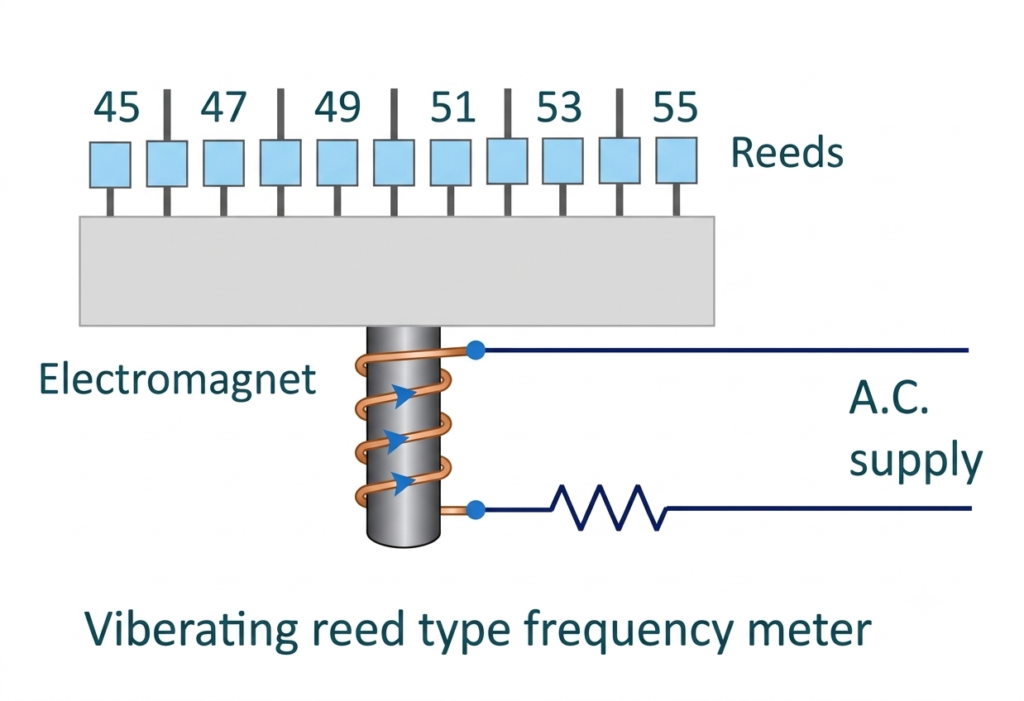
A vibrating reed frequency meter consists of the following main parts:
- Metal Reeds: The instrument contains several thin steel reeds of approximately equal length and dimensions. Each reed is designed to have a different natural frequency.
- Attached Weights: Small weights are fitted to the ends of the reeds. By changing the weight, each reed can be tuned to a particular resonant frequency.
- Common Base Plate: One end of each reed is fixed to a common base plate. This assembly supports the reeds and allows them to vibrate when subjected to magnetic excitation.
- Electromagnetic Coil: An electromagnet is positioned near the reeds. When the AC supply is applied to the coil, it produces a magnetic field that excites the reeds.
- Display Window: The free ends of the reeds are visible through a narrow opening in the meter housing. They are generally painted white so that their vibrations can be observed easily.
The reeds are arranged side by side, with each one representing a particular frequency value.
Working of Vibrating Reed Frequency Meter
The operation of a vibrating reed frequency meter can be understood by considering an AC supply of unknown frequency connected to its electromagnetic coil.
When the supply is applied, the coil produces a magnetic field that excites the reeds. Each reed responds according to its natural frequency.
The reed whose natural frequency is closest to the applied supply frequency vibrates with the greatest amplitude. The corresponding frequency marking indicates the measured supply frequency.
The following conditions may occur during measurement:
1. Applied Frequency Matches a Reed Frequency
When the supply frequency matches the natural frequency of one reed, that reed vibrates strongly due to resonance. The remaining reeds show comparatively smaller vibrations.
2. Applied Frequency Lies Midway Between Two Adjacent Reed Frequencies
If the applied frequency falls approximately midway between two neighboring reed frequencies, both reeds vibrate with nearly equal amplitudes. Their vibrations are generally smaller than the maximum vibration obtained at resonance.
3. Applied Frequency Is Closer to One of Two Adjacent Reed Frequencies
When the supply frequency lies between two neighboring reed frequencies but is closer to one of them, both reeds may vibrate. However, the reed having the closer natural frequency generally shows greater vibration.
By observing the reed with the maximum vibration, the operator can estimate the frequency of the AC supply.
Applications of Vibrating Reed Frequency Meter
Vibrating reed frequency meters are primarily designed for measuring AC supply frequencies around standard power-line values.
Their common applications include:
- Generator frequency measurement: Checking the output frequency of engine-driven generators and alternators.
- Generator speed adjustment: Helping operators adjust the prime mover speed to obtain the required output frequency.
- Power distribution panels: Monitoring the frequency of AC electrical supplies.
- Power stations: Providing a simple indication of generator frequency.
- Electrical switchboards: Monitoring supply frequency in industrial installations.
These instruments are particularly useful with portable engine-driven generators, where the operator needs to adjust the engine speed to maintain the required electrical frequency.
Advantages of Vibrating Reed Frequency Meter
The main advantages of a vibrating reed frequency meter are:
- Waveform independence: Its frequency indication is generally independent of the waveform of the applied voltage.
- Voltage magnitude independence: The indicated frequency is not directly dependent on supply voltage magnitude, provided the voltage is sufficient to produce clearly visible reed vibrations.
- Low cost: Its construction is relatively simple and economical.
- Simple operation: The frequency can be identified by observing the reed with maximum vibration.
- Rugged construction: Its electromechanical design makes it suitable for basic industrial frequency monitoring.
Disadvantages of Vibrating Reed Frequency Meter
Despite its simple construction, a vibrating reed frequency meter has certain limitations:
- Limited resolution: It cannot accurately distinguish frequencies that fall between adjacent reed markings. Its reading resolution depends on the frequency spacing between the reeds.
- Limited measurement range: Mechanical inertia restricts its use mainly to frequencies around standard power-line values, such as 50 Hz or 60 Hz.
- Tuning accuracy: Measurement accuracy depends on how precisely each reed is adjusted to its specified natural frequency.
- Visual observation: The operator must observe reed vibrations to determine the frequency.
- Limited precision: It is less suitable for applications requiring highly precise numerical frequency measurements.
Conclusion
A vibrating reed frequency meter is a simple electromechanical instrument that measures AC frequency using the principle of mechanical resonance. It consists of several metal reeds tuned to different natural frequencies and an electromagnet that excites them when an AC supply is applied.
The reed that vibrates with the greatest amplitude indicates the approximate supply frequency. Although its measurement range and resolution are limited, it remains useful for basic frequency monitoring in generator panels, electrical switchboards and power distribution systems.
Read Next:
- Analog Frequency Meter: Working, Types and Applications
- Digital Frequency Meter: Working Principle, Block Diagram, Construction
- Analog Instruments: Definition, Classification, and Working Principle
- Null Type Instrument: Principle, Example, and Key Advantages
- Types of Measuring Instruments in Electrical Engineering
- Integrating Instruments: Classifications, Advantage and Applications
- Digital Instruments: Definition, Characteristics, Construction, Advantages