The major types of galvanometer include moving coil, D’Arsonval, ballistic, tangent, mirror, astatic, and vibration galvanometers.
A galvanometer is a sensitive electrical instrument used to detect and measure small electric currents in an electrical circuit. It can indicate the presence and direction of current through the movement of a pointer or another indicating mechanism.
Different types of galvanometers are designed to perform specific measurement tasks. Some detect small direct currents (DC), while others measure electric charge, detect alternating current (AC), or observe rapidly changing electrical signals.
The types of galvanometer are classified according to their construction and operating principles. The important types are discussed below.
Different Types of Galvanometer
1. Moving Coil Galvanometer
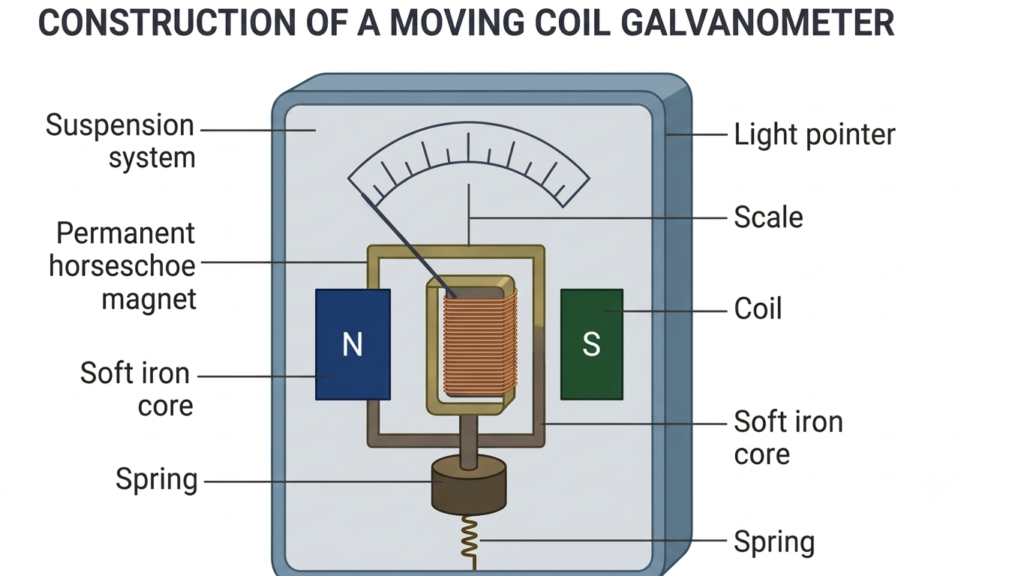
A moving coil galvanometer is an electromagnetic measuring instrument used to detect and measure small DC currents. It consists of a lightweight coil placed in the magnetic field of a permanent magnet.
When current passes through the coil, electromagnetic torque causes it to rotate. The resulting deflection indicates the magnitude of the current.
Moving coil galvanometers are widely used in electrical measuring instruments and form the operating basis of many analog DC ammeters and voltmeters.
2. D’Arsonval Galvanometer
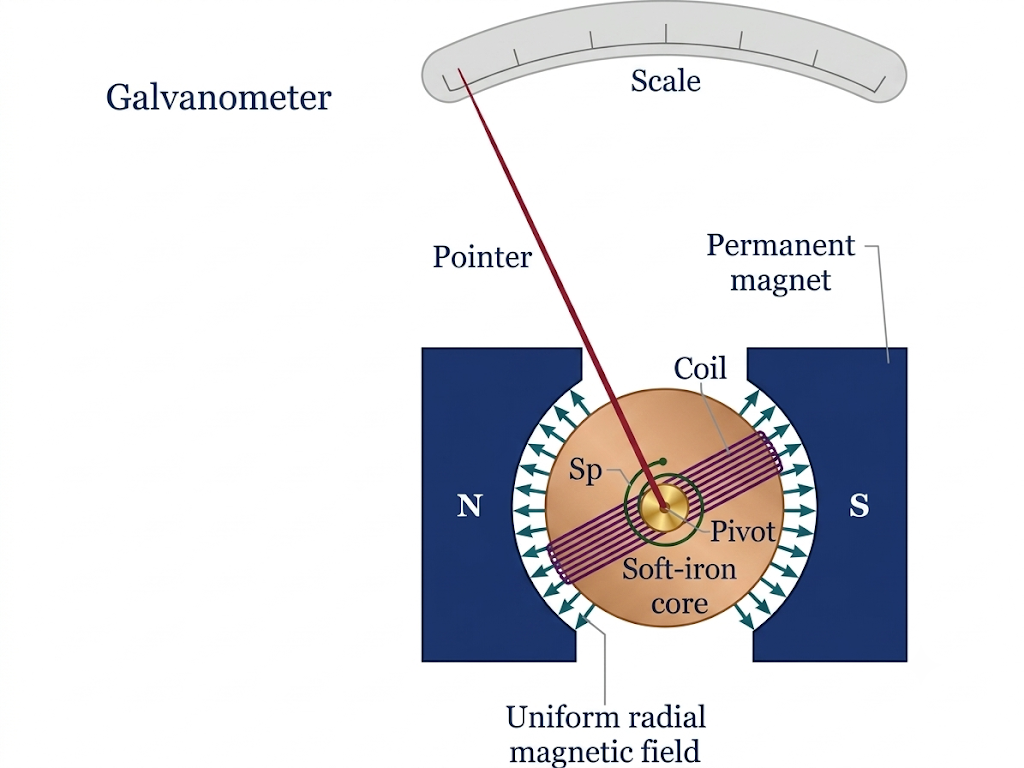
The D’Arsonval galvanometer is a popular moving coil galvanometer design that uses a lightweight coil suspended or pivoted between the poles of a permanent magnet.
Its operation is based on the electromagnetic force acting on a current-carrying conductor placed in a magnetic field. The coil rotates against the restoring torque of springs, producing a pointer deflection proportional to the current.
It is mainly used for sensitive DC measurements and is the basis of several analog electrical measuring instruments.
3. Ballistic Galvanometer
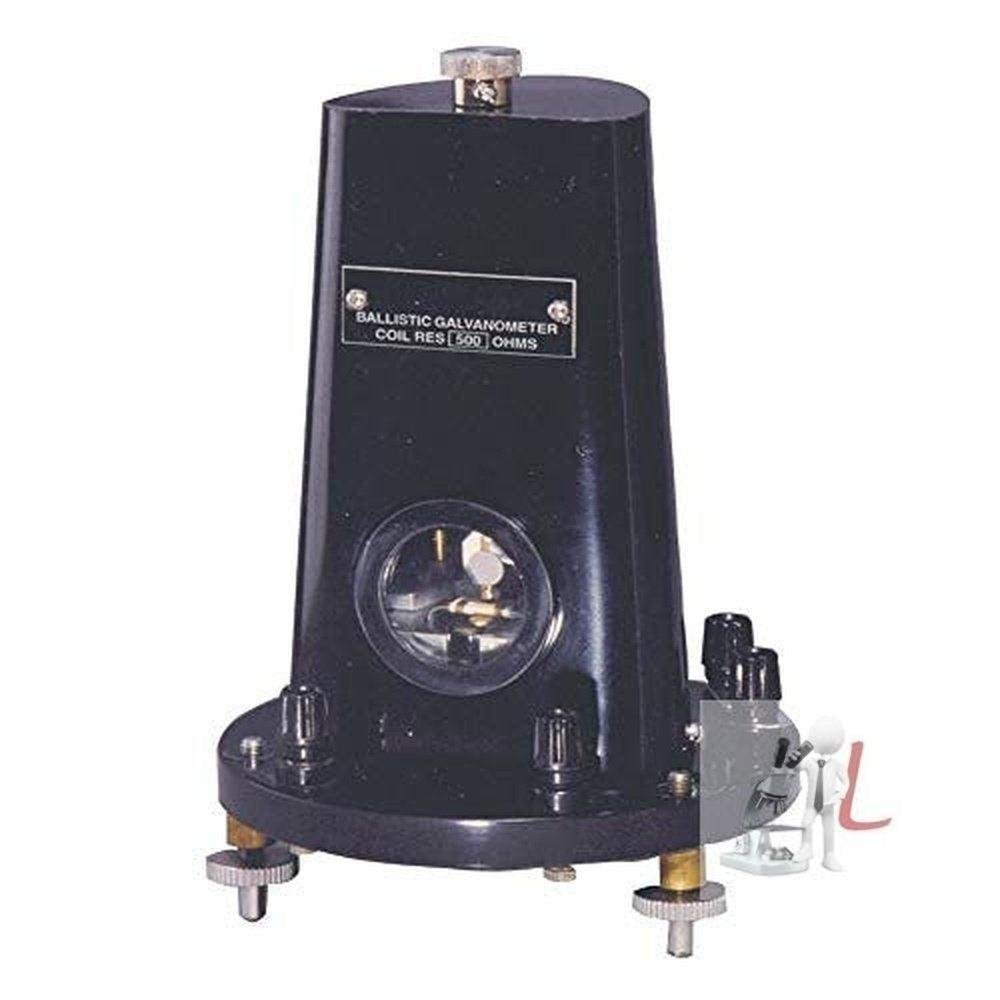
A ballistic galvanometer is a sensitive instrument designed to measure the total electric charge passing through a circuit during a short interval.
Unlike an ordinary galvanometer, which indicates current, a ballistic galvanometer measures the quantity of charge associated with a current pulse. It generally has a moving system with a large moment of inertia and a long oscillation period.
It is particularly useful in experiments involving electromagnetic induction, magnetic flux, and the measurement of electrical charge.
4. Tangent Galvanometer
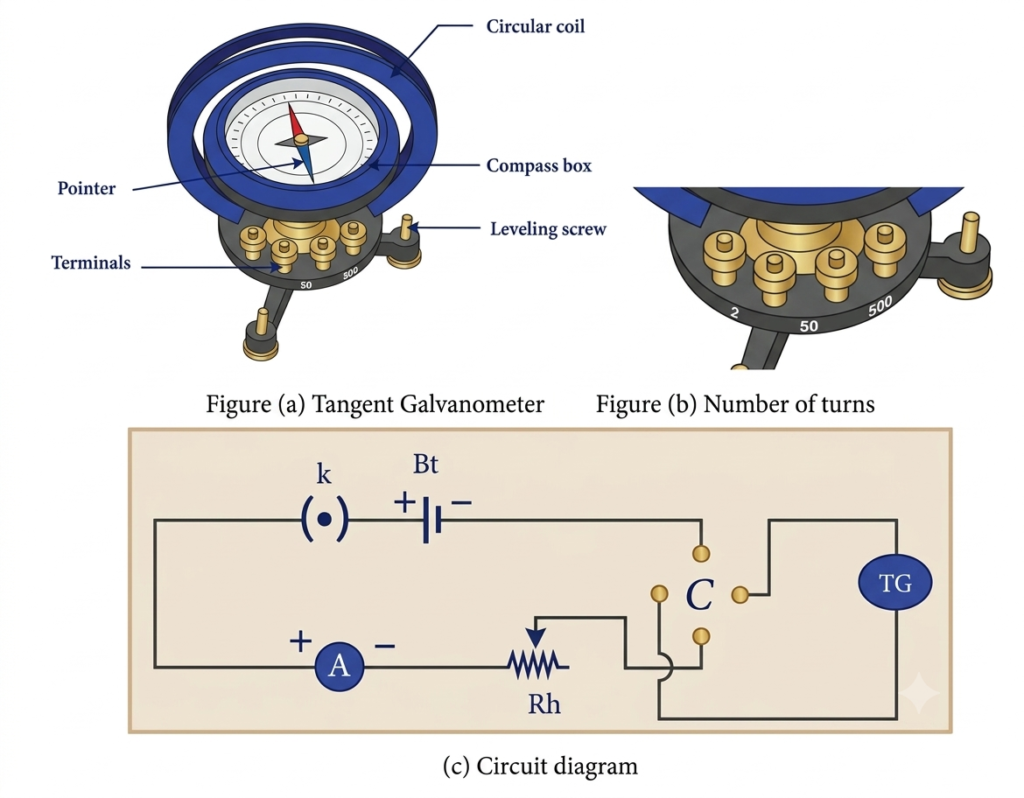
A tangent galvanometer is an early electrical measuring instrument that determines DC current using the tangent law of magnetism.
It consists of a circular coil mounted vertically with a magnetic compass placed at its centre. When current flows through the coil, the magnetic field produced by it interacts with Earth’s horizontal magnetic field, causing the compass needle to deflect.
The current is calculated from the deflection angle and the magnetic field relationship.
5. Mirror Galvanometer
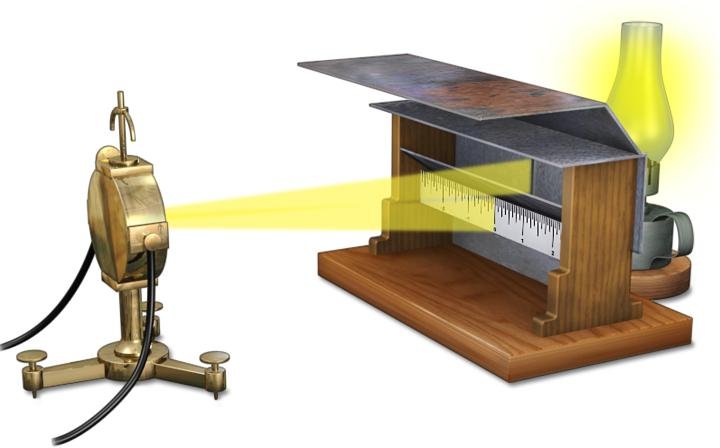
A mirror galvanometer is a highly sensitive instrument that uses a small mirror attached to its moving system to indicate electrical current through a reflected light beam.
When current passes through the coil, the mirror rotates and changes the direction of the reflected light. The movement of the light spot across a distant scale makes it possible to detect extremely small deflections.
Mirror galvanometers have been used in sensitive laboratory measurements, telecommunication experiments, and electrical recording instruments.
6. Astatic Galvanometer
An astatic galvanometer is designed to reduce the influence of Earth’s magnetic field on the measurement.
It generally uses two magnetic needles of approximately equal magnetic strength arranged with opposite polarities. Their magnetic effects largely cancel each other with respect to Earth’s magnetic field, reducing unwanted external magnetic influence.
This arrangement improves the instrument’s ability to detect small currents under suitable experimental conditions.
7. Vibration Galvanometer
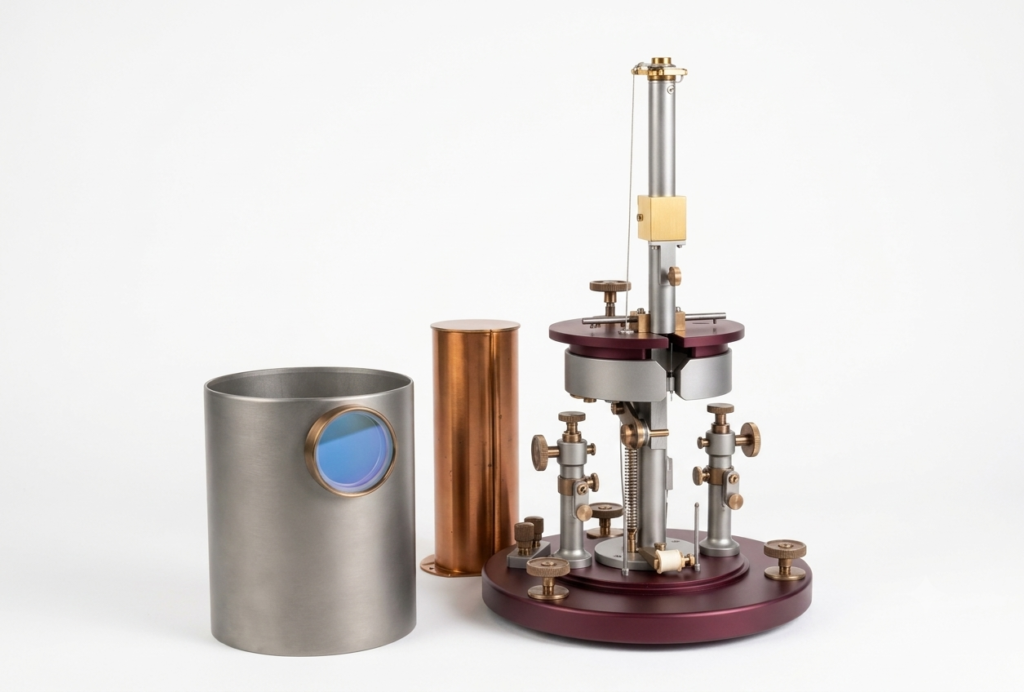
A vibration galvanometer is a tuned electrical measuring instrument primarily used for detecting alternating current in AC bridge circuits.
It operates on the principle of mechanical resonance. When the frequency of the applied alternating current matches the natural frequency of the moving system, the instrument produces maximum vibration.
It is commonly used as a sensitive null detector in AC bridge measurements, particularly for determining unknown inductance and capacitance.
8. Duddell’s Oscillograph Galvanometer
Duddell’s oscillograph galvanometer is a specialized high-frequency instrument developed for observing rapidly changing electrical currents and waveforms.
It uses a lightweight moving system that responds to variations in the applied current. Its rapid response makes it suitable for recording electrical oscillations and studying waveform characteristics.
It represents an important development in the history of electrical measurement and waveform recording.
Comparison of Different Types of Galvanometers
| Type | Main measuring purpose |
| Moving coil | Small DC currents |
| D’Arsonval | Sensitive DC current detection |
| Ballistic | Quantity of electric charge |
| Tangent | DC current using tangent law |
| Mirror | Very small electrical signals |
| Astatic | Current detection with reduced influence of Earth’s magnetic field |
| Vibration | AC detection and bridge balancing |
| Duddell’s oscillograph | Rapidly changing electrical signals |
How to Choose the Right Type of Galvanometer?
The selection of a galvanometer depends on the electrical quantity being measured and the required sensitivity.
- For DC current detection: A moving coil galvanometer is suitable.
- For sensitive DC measurements: A D’Arsonval galvanometer is commonly used.
- For measuring electric charge: A ballistic galvanometer is preferred.
- For demonstrating the tangent law: A tangent galvanometer is used.
- For detecting very small signals: A mirror galvanometer is useful.
- For reducing Earth’s magnetic field influence: An astatic galvanometer is preferred.
- For AC bridge measurements: A vibration galvanometer is suitable.
- For observing rapid electrical variations: An oscillograph galvanometer is used.
Conclusion
Different types of galvanometers serve different purposes in electrical measurement. Moving coil and D’Arsonval galvanometers are primarily associated with DC current detection, while ballistic galvanometers measure electric charge. Tangent galvanometers demonstrate the relationship between current and magnetic fields, whereas vibration galvanometers are used in AC bridge circuits. Mirror, astatic, and oscillograph galvanometers provide specialized measurement capabilities.
Understanding these classifications provides a foundation for studying the construction, working principles, characteristics, and applications of individual galvanometer types.
Read Next:
- Conversion of Galvanometer into Voltmeter: Formula, Derivation and Working
- Conversion of Galvanometer into Ammeter – Formula, Circuit Diagram and Derivation
- Applications of Galvanometer
- Galvanometer: Definition, Working Principle, Construction and Working
- Sensitivity of Galvanometer: Formula, Types, Factors and Explanation
- Figure of Merit of a Galvanometer: Formula, Experiment and Calculation
- Galvanometer Resistance: Formula, Calculation and Measurement