The figure of merit of a galvanometer is an important parameter used to determine the current required to produce one division of deflection in its pointer. It indicates the current sensitivity of a galvanometer and helps us understand how effectively the instrument detects small electric currents.
The figure of merit can be determined experimentally by connecting a galvanometer in series with a known resistance and measuring the deflection produced by a known current. It is generally expressed in amperes per division or microamperes per division.
In this article, we will discuss the figure of merit formula, its experimental determination, calculation with a solved example, and its relationship with galvanometer resistance.
Figure of Merit of Galvanometer Formula
The figure of merit of a galvanometer is defined as the amount of current required to produce one division of deflection in the galvanometer.
It is calculated by dividing the current flowing through the galvanometer by the number of divisions through which its pointer deflects.
The figure of merit formula is:
Where:
- = Figure of merit of galvanometer (A/division)
- = Current flowing through the galvanometer (A)
- = Deflection of the galvanometer pointer (divisions)
Using Ohm’s law, the current can be calculated as:
Substituting this value into the figure of merit formula:
Where:
- = EMF of the battery (V)
- = External resistance connected in series (Ω)
- = Resistance of the galvanometer (Ω)
Unit of figure of merit: The SI unit is ampere per division (A/division). In practical experiments, it is often expressed in microamperes per division (µA/division).
Important: A smaller figure of merit indicates that the galvanometer requires less current to produce one division of deflection. Therefore, it has greater current sensitivity.
Figure of Merit of Galvanometer Experiment
The figure of merit of a galvanometer can be determined experimentally using a battery, resistance box, galvanometer, key, and rheostat.
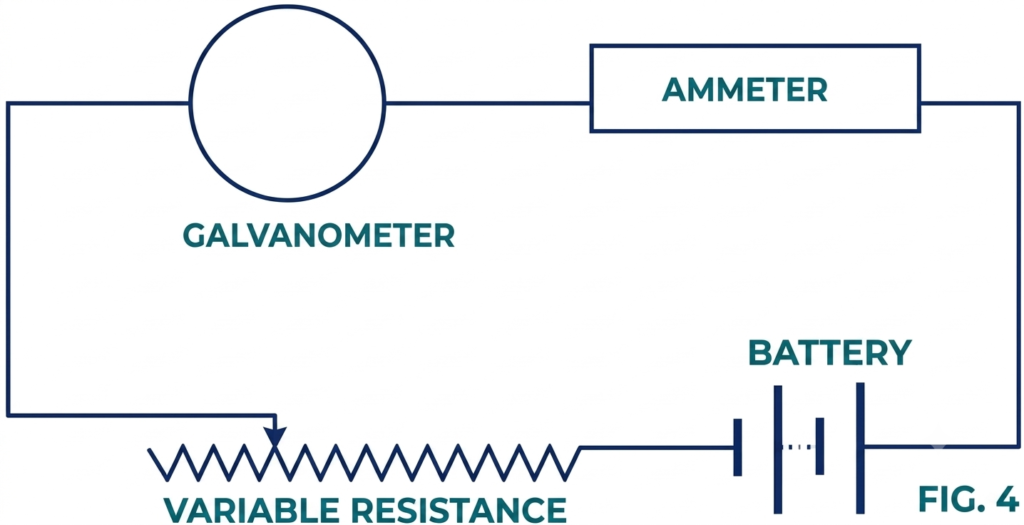
Aim
To determine the figure of merit of a given galvanometer using a resistance box and a battery.
Apparatus Required
The following apparatus is required for the experiment:
- Galvanometer
- Battery or DC power supply
- Resistance box
- Rheostat
- Plug key or switch
- Connecting wires
Theory
When a galvanometer is connected in series with a battery and a known external resistance, a small current flows through its coil.
This current produces a deflection in the galvanometer pointer. According to Ohm’s law, the current flowing through the circuit is:
The figure of merit is the current required to produce one division of deflection.
Therefore:
Combining both equations:
By measuring the battery voltage, external resistance, galvanometer resistance, and pointer deflection, the figure of merit can be calculated.
Experimental Procedure
Follow these steps to determine the figure of merit of a galvanometer:
- Connect the galvanometer, battery, resistance box, rheostat, and key in series.
- Ensure that all connections are properly tightened.
- Adjust the resistance box to a sufficiently high resistance initially to protect the galvanometer.
- Close the key and observe the deflection of the galvanometer pointer.
- Note the number of divisions indicated by the pointer.
- Record the corresponding external resistance and battery voltage.
- Repeat the experiment with different resistance values.
- Calculate the current flowing through the galvanometer for each observation.
- Determine the figure of merit by dividing the current by the corresponding deflection.
- Calculate the average figure of merit from the observations.
Observation Table
The following table shows a sample observation format for the experiment.
| S.No. | EMF (V) | Resistance (Ω) | Deflection (divisions) | Current (A) | Figure of merit (A/div.) |
| 1 | 2 | 10000 | 20 | To calculate | To calculate |
| 2 | 2 | 12000 | 17 | To calculate | To calculate |
| 3 | 2 | 15000 | 14 | To calculate | To calculate |
Note: These are illustrative readings. Actual observations depend on the galvanometer resistance and experimental setup.
Calculation
Calculate the current flowing through the galvanometer using Ohm’s law:
Then calculate the figure of merit:
The average value is:
Precautions
The following precautions should be taken during the experiment:
- Always use a high resistance initially to protect the galvanometer.
- Check the galvanometer zero setting before starting the experiment.
- Make all circuit connections correctly.
- Close the key only when taking observations.
- Avoid passing excessive current through the galvanometer.
- Take readings without parallax error.
- Ensure that the pointer moves freely without friction.
Figure of Merit of Ammeter
The figure of merit of an ammeter is generally understood as the current required to produce one scale division of deflection.
It can be expressed as:
Where:
- = Figure of merit of ammeter
- = Measured current (A)
- = Number of scale divisions
Its unit is amperes per division (A/division).
For example, if an ammeter shows a deflection of 50 divisions when a current of 5 A flows through it, its figure of merit is:
Note: The term figure of merit is most commonly used for a galvanometer. For a conventional ammeter, current range, least count, and accuracy are more commonly specified.
Figure of Merit of Voltmeter
For a voltmeter, the corresponding quantity can be expressed as the voltage required to produce one scale division of deflection.
It is calculated as:
Where:
- = Voltage per division
- = Applied voltage (V)
- = Number of scale divisions
Its unit is volts per division (V/division).
For example, if a voltmeter indicates 10 V at 50 divisions, then:
Note: This is the voltage scale value or least count per division, rather than the conventional galvanometer figure of merit.
How to Calculate the Figure of Merit of a Galvanometer
Let’s understand the calculation with a numerical example.
Example: A galvanometer has a resistance of 100 Ω and is connected in series with an external resistance of 9,900 Ω and a 10 V battery. If the galvanometer shows a deflection of 50 divisions, calculate its figure of merit.
Given data:
- Battery voltage,
- External resistance,
- Galvanometer resistance,
- Deflection, divisions
Step 1: Calculate the total resistance.
Step 2: Calculate the current flowing through the galvanometer.
According to Ohm’s law:
Step 3: Calculate the figure of merit.
Using the formula:
Substituting the values:
Therefore:
The figure of merit of the galvanometer is 20 µA per division.
Galvanometer Resistance Chart
The resistance of a galvanometer plays an important role in determining the current flowing through its coil and, consequently, its figure of merit.
The following table explains the important resistance-related parameters of a galvanometer.
| Parameter | Symbol | Description |
| Galvanometer resistance | G | Resistance of the galvanometer coil |
| External resistance | R | Resistance connected in series |
| Total resistance | RT | Sum of external and galvanometer resistance |
| Circuit current | I | Current flowing through the galvanometer |
| Figure of merit | K | Current required for one division of deflection |
| Current sensitivity | SI | Deflection produced per unit current |
The total circuit resistance is:
The circuit current is:
The figure of merit is:
Effect of Resistance on Figure of Merit:
For a fixed battery voltage and galvanometer deflection, increasing the external resistance reduces the circuit current. This also reduces the galvanometer deflection. Therefore, the resistance and deflection must be considered together when calculating the figure of merit.
Difference Between Figure of Merit and Current Sensitivity
Figure of merit and current sensitivity are closely related parameters, but they represent opposite quantities.
| Basis | Figure of Merit | Current Sensitivity |
| Definition | Current required for one division of deflection | Deflection produced per unit current |
| Formula | K = I/θ | SI = θ/I |
| Unit | A/division | Division/A |
| Meaning | Current requirement | Deflection response |
| Instrument performance | Lower value indicates higher sensitivity | Higher value indicates higher sensitivity |
| Relationship | K = 1/SI | SI = 1/K |
Thus, figure of merit is the reciprocal of current sensitivity.
Applications of Figure of Merit
The figure of merit of a galvanometer is useful in several electrical measurement applications.
1. Determining galvanometer sensitivity: It helps determine the amount of current required to produce a measurable pointer deflection.
2. Designing sensitive instruments: It is useful when selecting galvanometers for detecting very small currents.
3. Converting galvanometer into an ammeter: It helps in understanding the current response of the galvanometer movement before selecting a suitable shunt resistance.
4. Converting galvanometer into a voltmeter: It helps determine the current required for a particular deflection when designing a voltmeter using a series resistance.
5. Laboratory experiments: It is used in physics practicals to study the behaviour and sensitivity of moving-coil galvanometers.
Conclusion
The figure of merit of a galvanometer represents the current required to produce one division of pointer deflection. It is calculated using the formula \(K=I/\theta\), where \(I\) is the current flowing through the galvanometer and \(\theta\) is the corresponding deflection. Its unit is amperes per division.
The figure of merit can be determined experimentally using a battery, resistance box, and galvanometer. A lower figure of merit indicates greater current sensitivity, making the galvanometer capable of detecting smaller currents. Understanding this parameter is useful in electrical measurements and in converting galvanometers into ammeters and voltmeters.
Read Next:
- Conversion of Galvanometer into Voltmeter: Formula, Derivation and Working
- Conversion of Galvanometer into Ammeter – Formula, Circuit Diagram and Derivation
- Applications of Galvanometer
- Galvanometer: Definition, Working Principle, Construction and Working
- Sensitivity of Galvanometer: Formula, Types, Factors and Explanation
- Galvanometer Resistance: Formula, Calculation and Measurement