The sensitivity of a galvanometer indicates its ability to detect small electric currents and produce a noticeable pointer deflection. A highly sensitive galvanometer can detect even a very small current with a relatively large angular deflection. The sensitivity of galvanometer depends on its construction, magnetic field strength, number of coil turns, and restoring torque.
There are two important types of galvanometer sensitivity: current sensitivity and voltage sensitivity. Current sensitivity describes the deflection produced per unit current, whereas voltage sensitivity represents the deflection produced per unit applied voltage.
In this article, we will explain the sensitivity of a moving coil galvanometer, its formulas, mathematical derivations, influencing factors, and the relationship between current and voltage sensitivity.
Sensitivity of Galvanometer Formula
The sensitivity of a galvanometer is defined as the angular deflection produced per unit input. Depending on whether the input is current or voltage, it is classified into two types.
The general expression for galvanometer sensitivity is:
For a moving coil galvanometer, sensitivity is expressed as:
- Current sensitivity: Deflection per unit current.
- Voltage sensitivity: Deflection per unit voltage.
Current Sensitivity of Galvanometer
Current sensitivity of a galvanometer is defined as the angular deflection produced in the galvanometer per unit current flowing through its coil.
It indicates how effectively a galvanometer detects small changes in electric current. A higher current sensitivity means that a small current produces a larger pointer deflection.
Current Sensitivity Formula
The current sensitivity of a galvanometer is given by:
Where:
- = Current sensitivity (rad/A)
- = Angular deflection (radian)
- = Current flowing through the coil (A)
Derivation of Current Sensitivity
Consider a moving coil galvanometer having the following parameters:
- = Number of turns in the coil
- = Magnetic flux density (T)
- = Area of the coil (m²)
- = Current flowing through the coil (A)
- = Torsional constant of the suspension (N m/rad)
- = Angular deflection (radian)
When current flows through the coil placed in a magnetic field, a deflecting torque is produced.
The deflecting torque is:
The suspension produces an opposing restoring torque:
At equilibrium, both torques are equal.
Therefore,
Rearranging:
Hence, the current sensitivity is:
This equation shows that current sensitivity increases with the number of coil turns, magnetic field strength, and coil area. It decreases when the torsional constant increases.
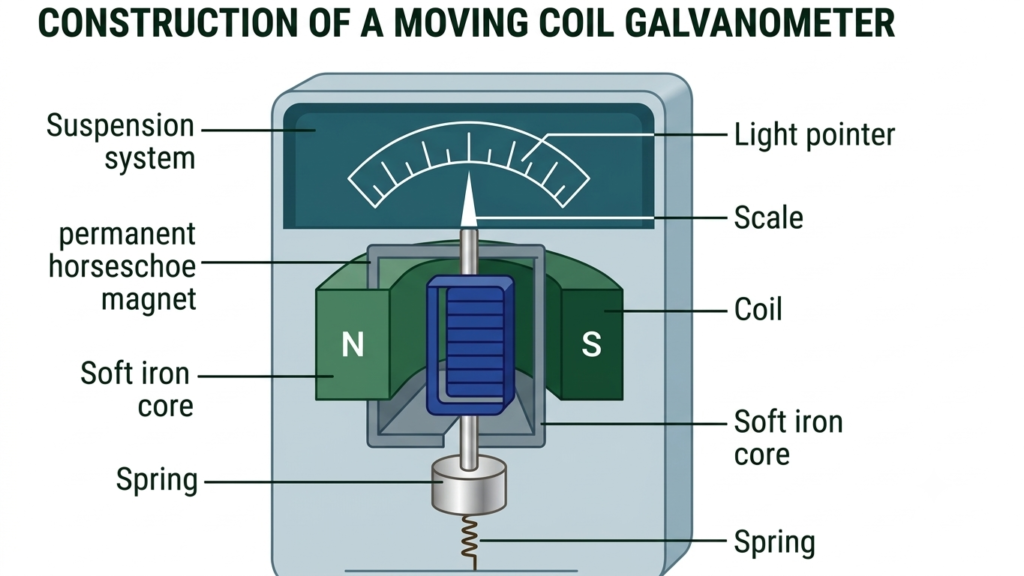
Voltage Sensitivity of Galvanometer
Voltage sensitivity of a galvanometer is defined as the angular deflection produced per unit voltage applied across its terminals.
It indicates how much the galvanometer pointer moves for a given potential difference.
Voltage Sensitivity Formula
The voltage sensitivity of a galvanometer is:
Where:
- = Voltage sensitivity (rad/V)
- = Angular deflection (radian)
- = Applied voltage (V)
Derivation of Voltage Sensitivity
According to Ohm’s law, the voltage applied across a galvanometer is:
Where:
- = Current flowing through the coil
- = Internal resistance of galvanometer
Therefore,
The current sensitivity is:
Substituting :
Rearranging:
Therefore, voltage sensitivity is:
Since current sensitivity is:
The voltage sensitivity can also be expressed as:
Thus, voltage sensitivity depends on the magnetic field strength, number of turns, coil area, torsional constant, and internal resistance of the galvanometer.
Internal Resistance of Galvanometer
The internal resistance of a galvanometer is the electrical resistance offered by its moving coil to the flow of current.
It is generally represented by and measured in ohms (Ω).
The internal resistance depends on the material, length, cross-sectional area, and temperature of the coil.
According to the resistance formula:
Where:
- = Internal resistance (Ω)
- = Resistivity of coil material (Ω m)
- = Length of the coil wire (m)
- = Cross-sectional area of the wire (m²)
Importance of Internal Resistance
Internal resistance plays an important role in determining the voltage sensitivity of a galvanometer.
From the relationship:
For a given current sensitivity, voltage sensitivity increases when the internal resistance decreases.
A galvanometer with low internal resistance generally has higher voltage sensitivity, provided its current sensitivity remains unchanged.
Factors Affecting Sensitivity of Moving Coil Galvanometer
The sensitivity of moving coil galvanometer depends on several constructional and mechanical parameters.
From the current sensitivity formula:
The important factors are explained below.
1. Number of Turns of the Coil (N)
Current sensitivity is directly proportional to the number of turns in the coil.
Increasing the number of turns increases the deflecting torque for the same current. Therefore, the pointer produces greater deflection.
2. Magnetic Field Strength (B)
The sensitivity is directly proportional to the magnetic flux density.
A stronger magnetic field produces greater deflecting torque and improves the sensitivity of the galvanometer.
3. Area of the Coil (A)
Current sensitivity is directly proportional to the area of the coil.
A larger coil area produces greater electromagnetic torque for the same current.
4. Torsional Constant (C)
The torsional constant represents the restoring torque required per unit angular deflection.
A lower torsional constant produces greater deflection for the same current. Therefore, reducing the torsional constant increases current sensitivity.
5. Internal Resistance (G)
Internal resistance affects voltage sensitivity rather than the current sensitivity directly.
For a given current sensitivity, reducing internal resistance increases voltage sensitivity.
Difference Between Current Sensitivity and Voltage Sensitivity of Galvanometer
Current sensitivity and voltage sensitivity are two important characteristics of a galvanometer. Both indicate the ability of the instrument to detect small electrical inputs, but they are defined differently.
| Basis | Current Sensitivity | Voltage Sensitivity |
| Definition | Deflection per unit current | Deflection per unit voltage |
| Formula | θ/I | θ/V |
| Expression | NBA/C | NBA/(CG) |
| Unit | rad/A | rad/V |
| Depends on | Coil turns, area, magnetic field and torsional constant | Current sensitivity and internal resistance |
| Higher value indicates | Greater deflection for a small current | Greater deflection for a small voltage |
Relationship Between Current Sensitivity and Voltage Sensitivity
The relationship between current sensitivity and voltage sensitivity is obtained using Ohm’s law.
We know that:
Current sensitivity is:
Voltage sensitivity is:
Substituting :
Therefore:
Alternatively:
This relationship shows that voltage sensitivity is equal to current sensitivity divided by the internal resistance of the galvanometer.
How to Increase the Sensitivity of a Galvanometer?
The sensitivity of a moving coil galvanometer can be increased by making suitable changes in its design.
The following methods are commonly used:
- Increase the number of turns in the coil to produce greater magnetic torque.
- Increase the magnetic field strength by using a stronger permanent magnet.
- Increase the area of the moving coil to improve deflecting torque.
- Reduce the torsional constant of the suspension to obtain greater angular deflection.
- Use a suitable coil design and magnetic circuit to obtain a strong and uniform radial magnetic field.
For voltage sensitivity, reducing the internal resistance can also improve sensitivity if current sensitivity remains unchanged.
However, practical design involves trade-offs. For example, increasing the number of turns may also increase the coil resistance and moving mass.
Conclusion
The sensitivity of galvanometer indicates its ability to produce angular deflection in response to a small electrical input. It is mainly classified into current sensitivity and voltage sensitivity. Current sensitivity is the deflection produced per unit current, whereas voltage sensitivity is the deflection produced per unit applied voltage.
For a moving coil galvanometer, current sensitivity depends on the number of turns, magnetic field strength, coil area, and torsional constant. Voltage sensitivity additionally depends on the internal resistance of the coil. Increasing the magnetic field strength, coil turns, and coil area while reducing the torsional constant can improve current sensitivity.
Read Next:
- Conversion of Galvanometer into Voltmeter: Formula, Derivation and Working
- Conversion of Galvanometer into Ammeter – Formula, Circuit Diagram and Derivation
- Applications of Galvanometer
- Galvanometer: Definition, Working Principle, Construction and Working
- Figure of Merit of a Galvanometer: Formula, Experiment and Calculation
- Galvanometer Resistance: Formula, Calculation and Measurement
- Galvanometer Resistance: Formula, Calculation and Measurement