The applications of galvanometer cover a wide range of electrical and electronic measurements. A galvanometer is a sensitive measuring instrument used to detect small electric currents, determine their direction, and identify the presence of current in a circuit. Due to its ability to detect very small electrical signals, it is widely used in electrical measurements, laboratory experiments, and electronic control systems.
Although modern digital instruments have replaced galvanometers in many applications, their operating principle remains important in electrical and electronic engineering. Galvanometers are also used in several devices where accurate mechanical movement or position control is required.
Objectives and Functions of Galvanometer
The development of the galvanometer is closely associated with the discovery of the relationship between electricity and magnetism.
In 1820, Danish physicist Hans Christian Ørsted discovered that an electric current flowing through a conductor could deflect a nearby magnetic compass needle. This observation established an important connection between electrical current and magnetic effects.
Later, André-Marie Ampère investigated this relationship and developed mathematical explanations for the magnetic effects of electric currents. These discoveries contributed to the development of electromagnetic measuring instruments, including the galvanometer.
A modern moving-coil galvanometer operates by converting electrical energy into mechanical movement. When current passes through a coil placed in a magnetic field, a torque is produced, causing the coil to rotate.
The main functions of a galvanometer include:
- Detecting the presence of electric current in a circuit.
- Determining the direction of current flow.
- Measuring small electrical currents.
- Identifying the null point in electrical bridge circuits.
- Detecting small changes in electrical signals.
- Serving as the basic measuring mechanism for certain ammeters and voltmeters.
Applications of Galvanometer
Galvanometers are used in different electrical, electronic, and measurement applications. Some important applications are explained below.
1. Detection of Electric Current: A galvanometer detects whether current is flowing through a circuit. Its pointer deflects when current passes through the moving coil.
2. Measurement of Small Current: It is used to measure very small currents that may not be easily detected using ordinary measuring instruments.
3. Determination of Current Direction: The direction of pointer deflection indicates the direction of current flowing through a sensitive galvanometer.
4. Null Point Detection: Galvanometers are used in Wheatstone bridges and other electrical bridge circuits to identify the balanced condition or null point.
5. Electronic Control Systems: Galvanometer mechanisms are used in certain control systems where electrical signals must be converted into precise mechanical movements.
6. Laser Applications: Special galvanometer scanners control the angular position of mirrors used to direct laser beams in laser engraving, marking, scanning, and display systems.
7. CD/DVD Players and Hard Drives: Galvanometer-type actuators and related electromagnetic positioning mechanisms have been used in optical and magnetic storage devices to control the movement of reading or writing components.
8. Photography: Sensitive galvanometer mechanisms have been used in some camera exposure-meter systems to indicate light intensity measured by photoelectric sensors.
9. Educational Laboratories: Galvanometers are widely used in physics and electrical engineering laboratories to demonstrate current detection, electromagnetic effects, and the working principles of measuring instruments.
Applications of Galvanometer as an Ammeter and Voltmeter
A galvanometer can be converted into an ammeter or voltmeter by connecting a suitable resistance to its moving coil. The type and connection of resistance determine the function and measurement range of the instrument.
1. Galvanometer as a Voltmeter
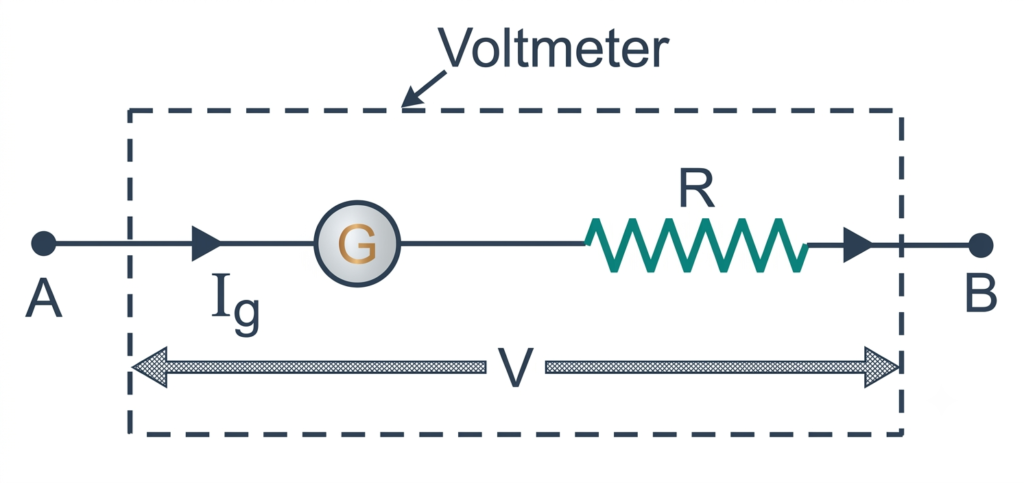
A galvanometer can be converted into a voltmeter by connecting a high resistance, known as a multiplier resistance, in series with its moving coil.
The series resistance limits the current flowing through the galvanometer and allows it to measure a higher potential difference without exceeding its full-scale current rating.
The combination is connected in parallel across the two points where voltage is to be measured.
The voltage measurement range can be increased by selecting a suitable value of series resistance.
The required series resistance is calculated using:
Where:
- = Series multiplier resistance.
- = Maximum voltage to be measured.
- = Full-scale deflection current of galvanometer.
- = Internal resistance of galvanometer.
2. Galvanometer as an Ammeter
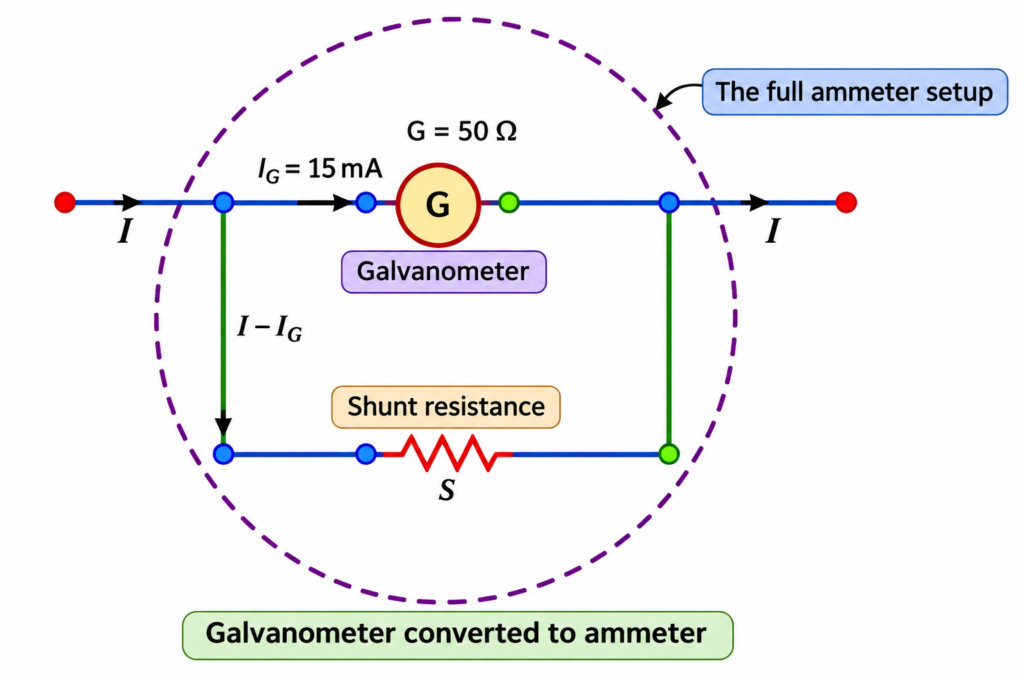
A galvanometer can be converted into an ammeter by connecting a very low resistance in parallel with its moving coil. This parallel resistance is known as a shunt resistance.
When the instrument is connected in a circuit, most of the current passes through the shunt resistance, while only a small portion flows through the galvanometer coil.
This arrangement protects the delicate moving coil from excessive current and extends the current measurement range.
The complete ammeter is connected in series with the load whose current is to be measured.
The shunt resistance is calculated using:
Where:
- = Shunt resistance.
- = Full-scale deflection current.
- = Internal resistance of galvanometer.
- = Maximum current to be measured.
Types of Galvanometers
Galvanometers are available in different designs depending on their construction, operating principle, and intended measurement purpose.
Some traditional types include:
- Kelvin’s Astatic Galvanometer
- Ballistic Galvanometer
- Tangent Galvanometer
- Pye Coulomb Balance
- Iron Vane Galvanometer
- Universal Tangent Galvanometer
- Kohlrausch Galvanometer
- Horizontal Galvanometer
- Brass Cylindrical Galvanometer
These instruments differ in their construction and measurement characteristics. For example, a ballistic galvanometer is designed to measure the quantity of electric charge passing through its coil, whereas a tangent galvanometer uses the tangent law to determine current from the deflection of a magnetic needle.
Classification of Galvanometers
Galvanometers can be classified according to their operating characteristics and construction.
1. Based on Operating Characteristics
According to their response to current, galvanometers can be classified into the following categories:
Ballistic Galvanometer: A ballistic galvanometer is designed to measure the quantity of electric charge passing through its coil during a short-duration electrical event. It is commonly used in experiments involving electromagnetic induction and capacitor discharge.
Dead-Beat Galvanometer: A dead-beat galvanometer reaches its final steady position quickly without significant oscillations. It is suitable for detecting steady or slowly changing currents.
Periodic Galvanometer: A periodic galvanometer oscillates around its equilibrium position before settling. Its moving system has a measurable natural period of oscillation.
2. Based on Construction
According to the movement of the magnetic system, galvanometers can be classified into two main types:
Moving Coil Galvanometer: In this type, a current-carrying coil rotates in the magnetic field of a permanent magnet. The resulting deflection indicates the magnitude of the current.
Moving Magnet Galvanometer: In this arrangement, a magnet moves in response to the magnetic field produced by a current-carrying stationary coil.
Both types may use pivoted or suspended moving systems, depending on their mechanical construction.
Conclusion
A galvanometer is an important electrical measuring instrument used for detecting small currents, determining current direction, and identifying null points in electrical circuits. Its basic operating principle is also used in the construction of ammeters and voltmeters. Different galvanometer designs serve specific measurement and control applications, including laboratory instruments, laser scanning systems, and electromagnetic positioning mechanisms.
Read Next:
- Galvanometer: Definition, Construction, Working
- Null Type Instrument: Principle, Example, and Key Advantages
- Types of Measuring Instruments in Electrical Engineering
- Integrating Instruments: Classifications, Advantage and Applications
- Digital Instruments: Definition, Characteristics, Construction, Advantages, and Disadvantages
- Analog Instruments: Definition, Classification, and Working Principle
- Ammeter Shunt: Definition, Working Principle, Construction, Circuit Diagram, Formula and Applications
- Types of Voltmeter and Working Principle of Voltmeter
- Conversion of Galvanometer into Ammeter – Formula, Circuit Diagram and Derivation