Accurate energy measurement is important for reliable monitoring, billing, and energy management. Energy Meter Calibration helps verify the accuracy of energy meters and ensures that they provide reliable and consistent readings.
What Is Energy Meter Calibration?
Energy meter calibration is the process of checking an energy meter against a reliable reference standard. The meter is tested under specified electrical conditions, and its readings are compared with the reference value.
During calibration, any difference between the meter reading and the reference value is determined as measurement error. Where applicable, the meter can then be adjusted to reduce this error and bring its performance within the required accuracy limits.
Calibration can help identify errors caused by inaccurate voltage or current measurement, phase-angle differences, component tolerances, and other factors affecting meter performance. As a result, proper calibration helps ensure that the energy meter continues to deliver accurate and dependable measurements.
Energy Meter Calibration Procedure
The calibration of an energy meter is carried out under controlled conditions. The main steps are as follows:
- Prepare the Meter:
Connect the meter correctly to the test circuit. The current coil is connected in series with the load, while the voltage coil is connected across the supply. Allow the meter to run for about 15 minutes before taking readings. - Connect a Known Load:
Use a load with a known power rating. For example, a 1 kW load running for one hour should consume 1 kWh of energy. This value can be used as the reference for the test. - Take the Readings:
Record the supply voltage, load current, and test duration. For an electromechanical meter, note the time taken for a specified number of disc revolutions. For an electronic meter, the corresponding pulses can be counted. - Compare the Energy Values:
Calculate the actual energy consumed by the load and compare it with the energy recorded by the meter. Any difference between the two values indicates an error in the meter reading. - Calculate the Error:
Determine the percentage error by comparing the meter reading with the reference energy value. This shows whether the meter is reading higher or lower than the actual energy consumed. - Adjust the Meter:
If the error is outside the permitted limit, the meter may need adjustment. In electromechanical meters, adjustments may include compensation for friction, creep, and phase or lag errors. - Repeat the Test:
Test the meter at different load levels to check its accuracy across the operating range. For more complete testing, different power-factor conditions may also be used. - Review the Results:
The calibration results can be plotted as a graph of percentage error versus load current. This makes it easier to identify changes in meter accuracy and overall performance.
Percentage Error
The percentage error of an energy meter can be calculated by comparing the meter reading with the reference or actual energy value:
A positive value indicates that the meter is over-registering, while a negative value indicates that it is under-registering.
Calibration of a Single-Phase Energy Meter by Direct Loading Method
The direct loading method is a simple way to check the accuracy of a single-phase energy meter. In this method, a known electrical load is connected to the meter, and its energy reading is compared with the expected energy consumption.
For example, a 1 kW load can be used for the test. A set of ten 100 W lamps provides a total load of 1 kW.
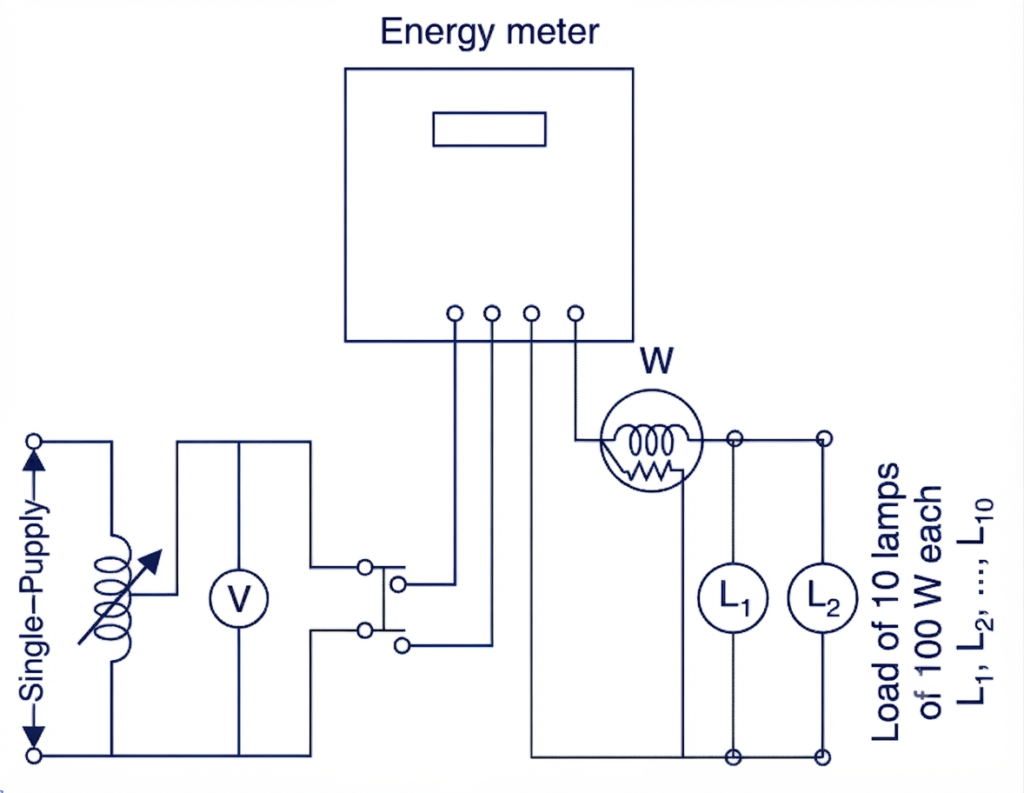
First, connect the energy meter and load correctly. Allow the setup to stabilize before starting the test. Then, note the initial meter reading.
Next, switch on all ten lamps and operate the load for one hour. The test time can be measured using a stopwatch. Since the load is 1 kW, the expected energy consumption is:
Therefore, after one hour, the energy meter should indicate an increase of approximately 1 kWh, or one unit of electrical energy.
If the meter reading differs from the expected value, the percentage error can be calculated. Where adjustment is permitted, the meter can then be adjusted to bring its accuracy within the specified limits.
Finally, the test can be repeated with different load levels and test durations. This helps verify the accuracy of the energy meter over its operating range.
Energy Meter Calibration Precautions
While calibrating an energy meter, the following precautions should be taken:
- Check all connections: Make sure all connections are tight, secure, and properly insulated. Never work with loose connections.
- Avoid direct contact: Do not touch the calibration circuit or its terminals while the circuit is energized. Use proper safety measures when taking readings.
- Allow the meter to stabilize: Connect the meter to the load for about 15 minutes before taking readings. This allows the meter to reach stable operating conditions.
- Record readings carefully: Note the voltage, current, time, and meter readings accurately to avoid errors in calculation.
- Take multiple readings: For better accuracy, take several readings and use their average value when determining the meter error.
Importance of Calibration
Energy meter calibration is important for maintaining accurate and reliable energy measurements. It provides several key benefits:
- Accuracy: Ensures that the energy meter provides correct readings for billing, monitoring, and energy management.
- Error Minimization: Helps identify and reduce measurement errors that can result in incorrect energy readings and financial losses.
- Compliance: Helps ensure that the meter operates within the required accuracy limits and applicable standards.
Therefore, regular calibration helps maintain reliable energy measurements and supports effective energy management.
Indian Standards for Energy Meter Calibration
In India, energy meters are required to meet the applicable Bureau of Indian Standards (BIS) requirements. These standards specify the construction, performance, accuracy, and testing requirements for different types of energy meters.
For AC static watt-hour meters, IS 13779 is an important standard. It covers static energy meters of accuracy Classes 1 and 2 used for measuring active electrical energy.
The accuracy class of a meter indicates its permissible measurement error under specified test conditions. Common accuracy classes include Class 1, Class 0.5, and Class 0.2, although the applicable class depends on the meter type and its intended application.
During calibration, the meter is tested under specified conditions of voltage, current, frequency, and power factor. The measured error must remain within the permissible limits specified by the applicable standard.
The calibration or verification interval is not necessarily the same for every meter. It depends on factors such as the type of meter, its application, utility requirements, and applicable regulatory provisions. Therefore, the required calibration interval should be determined according to the relevant utility or regulatory requirements.
International Standards for Energy Meter Calibration
Internationally, the IEC 62053 series provides important requirements for electricity metering equipment. Different parts of this series cover meters with different accuracy classes and measurement functions.
- IEC 62053-21: Covers static meters for active energy with accuracy Classes 1 and 2.
- IEC 62053-22: Covers static meters for active energy with accuracy Classes 0.2S and 0.5S.
- IEC 62053-23: Covers static meters for reactive energy with accuracy Classes 2 and 3.
These standards specify requirements for meter accuracy and performance under defined reference and test conditions. Parameters such as voltage, current, frequency, power factor, and temperature are considered during testing.
Therefore, following the applicable BIS or IEC requirements helps ensure that an energy meter provides accurate and reliable energy measurements.
Conclusion
Energy Meter Calibration is essential for maintaining accurate and reliable energy measurements. It helps identify measurement errors and ensures that the meter operates within the required accuracy limits. By following the correct calibration procedure, taking multiple readings, calculating the percentage error, and observing necessary safety precautions, the accuracy and reliability of energy meters can be maintained.
Read Next: