A single phase energy meter is an electrical measuring instrument used to measure the electrical energy consumed by residential buildings, small offices, shops, and other installations supplied by a single-phase AC power system. The measured energy is generally expressed in kilowatt-hours (kWh), which is commonly called a unit of electricity.
Single phase energy meters are available in electromechanical, electronic, digital, and smart meter designs. Traditional induction-type meters use a rotating aluminium disc to measure energy consumption, whereas modern electronic meters use electronic sensing circuits and digital processing to calculate and display energy usage.
This article explains the construction, working principle, types, features, wiring considerations, advantages, and applications of a single phase energy meter.
What Is a Single Phase Energy Meter?
A single phase energy meter measures the total electrical energy consumed by connected loads over a period of time. It is commonly installed in a single-phase, two-wire AC supply system consisting of phase and neutral conductors.
The meter measures electrical energy rather than instantaneous power. For example, if a 1 kW load operates continuously for two hours, it consumes 2 kWh of electrical energy.
The basic relationship between electrical energy, power, and time is:
Where:
- = electrical energy consumed in kWh
- = electrical power in kW
- = operating time in hours
For an AC load, real power depends on the supply voltage, current, and power factor:
Where:
- = RMS supply voltage
- = RMS load current
- = power factor
The meter continuously accumulates the energy consumed by the connected loads and displays the result in kWh.
Construction of a Single Phase Energy Meter
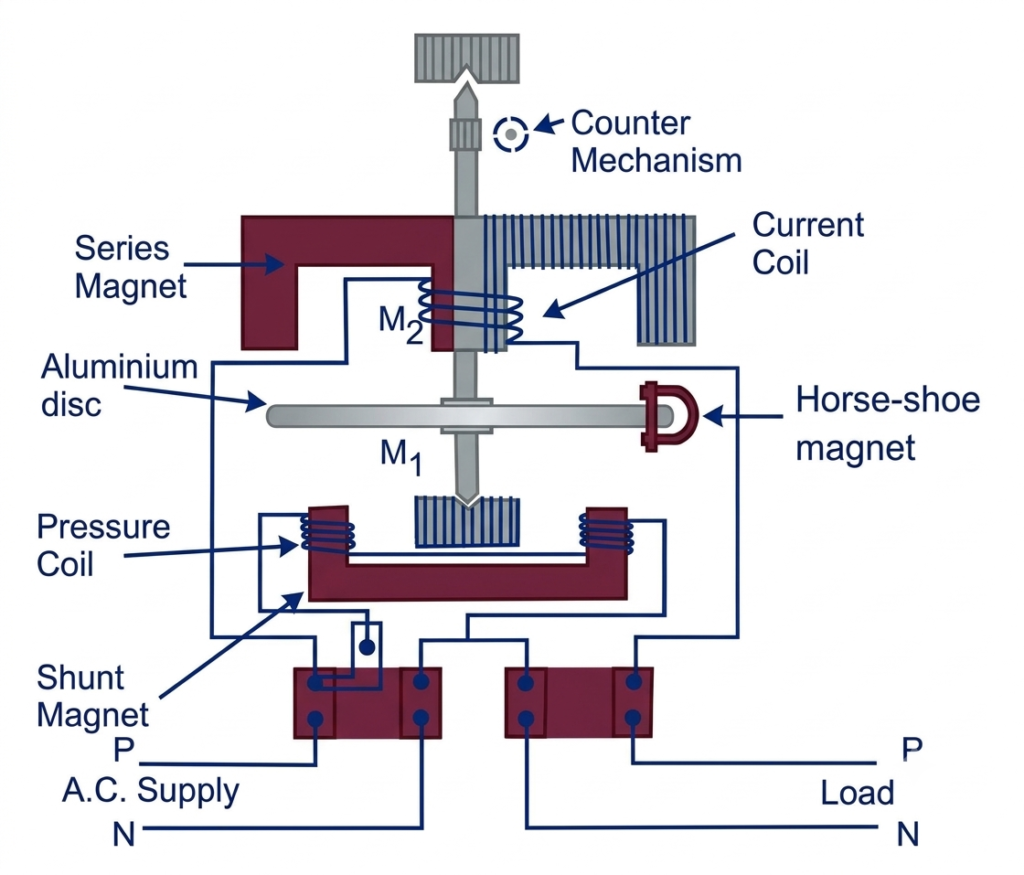
The construction depends on whether the meter is electromechanical or electronic. The traditional induction-type energy meter consists of the following main components.
1. Current Coil or Series Magnet
The current coil is made of thick copper wire with relatively few turns. It is connected in series with the load, so the load current flows through it.
The magnetic field produced by this coil depends on the magnitude of the load current. This field contributes to the driving torque that rotates the aluminium disc.
2. Pressure Coil or Shunt Magnet
The pressure coil consists of a large number of turns of fine copper wire. It is connected across the supply voltage through a suitable high-impedance circuit.
The coil produces a magnetic flux related to the applied voltage. Its magnetic circuit is designed to create the required phase relationship between the voltage-related flux and the supply waveform.
3. Aluminium Disc
A lightweight aluminium disc is mounted on a spindle and positioned within the magnetic fields produced by the current and pressure coils.
The interaction between the magnetic fluxes and the eddy currents induced in the disc produces a driving torque. The disc rotates at a speed related to the active power consumed by the load.
4. Permanent Braking Magnet
A permanent magnet is positioned near the rotating disc. As the disc moves through its magnetic field, eddy currents are induced in the disc.
These currents produce a braking torque that opposes the disc’s motion. The braking system helps establish the relationship between disc speed and measured power.
5. Spindle and Registering Mechanism
The spindle transfers the disc’s rotation to a gear train and registering mechanism.
The register counts the disc revolutions and converts them into a cumulative energy reading, usually expressed in kWh. Traditional meters may use mechanical number dials, while electronic meters display the reading digitally.
6. Bearings and Enclosure
Bearings support the spindle and allow the disc to rotate with minimal friction. The enclosure protects the internal mechanism from dust, accidental contact, and environmental influences.
Modern meters may also include terminal covers, security seals, and tamper-detection features.
Working Principle of a Single Phase Energy Meter
The working principle depends on the type of meter. A traditional electromechanical single phase energy meter operates on electromagnetic induction, while an electronic meter calculates energy using voltage and current measurements.
Working of an Induction-Type Energy Meter
The induction-type energy meter operates through the interaction of alternating magnetic fluxes and eddy currents in a rotating aluminium disc.
The working process can be explained in the following steps.
Step 1: Voltage coil produces magnetic flux. The pressure coil is connected across the supply and produces a magnetic flux related to the supply voltage.
Step 2: Current coil produces magnetic flux. The current coil is connected in series with the load and produces a magnetic flux related to the load current.
Step 3: Eddy currents are induced in the disc. The alternating magnetic fluxes induce eddy currents in the aluminium disc.
Step 4: Driving torque is produced. The interaction between the magnetic fluxes and the eddy currents produces a driving torque. The design and phase relationship of the fluxes make the average driving torque proportional to active power under the meter’s intended operating conditions.
Where is the driving torque.
Step 5: The disc rotates. The driving torque causes the disc to rotate. A permanent magnet produces braking torque, which increases with disc speed.
Step 6: Energy is registered. Under normal operating conditions, the disc reaches a speed related to active power. The total number of revolutions over time is proportional to the energy consumed. The register converts these revolutions into kWh.
Thus, the induction-type energy meter measures electrical energy by counting disc revolutions over time.
Working of an Electronic Single Phase Energy Meter
An electronic energy meter uses voltage and current sensing circuits to obtain electrical signals representing the supply voltage and load current.
An electronic metering circuit processes these signals, calculates active power, and integrates the power measurement over time to determine energy consumption.
The calculated energy is stored in electronic registers and displayed on an LCD or LED display. Depending on the model, the meter may also provide pulse outputs, communication interfaces, event records, and remote-reading capabilities.
Electronic meters do not require a rotating aluminium disc.
Types of Single Phase Energy Meters
Single phase energy meters can be classified according to their measuring technology and functionality.
1. Electromechanical Energy Meter
An electromechanical meter, also known as an induction-type energy meter, uses a rotating aluminium disc, electromagnetic coils, a braking magnet, and a mechanical register.
Its construction is relatively simple, but moving parts can be affected by friction, wear, and mechanical aging.
2. Electronic Energy Meter
An electronic energy meter uses electronic circuits to measure voltage and current and calculate energy consumption.
It generally provides a digital display and can offer improved measurement capabilities, depending on its design and accuracy class.
3. Digital Multifunction Energy Meter
A digital multifunction meter can display energy consumption along with other electrical parameters.
Depending on the model, these parameters may include:
- Supply voltage
- Load current
- Active power in kW
- Apparent power in kVA
- Power factor
- Frequency
- Cumulative energy consumption in kWh
Not every single phase energy meter measures or displays all these parameters.
4. Smart Energy Meter
A smart meter adds communication and data-management capabilities to energy measurement. Depending on its design and the utility’s system, it may support remote meter reading, interval energy records, event monitoring, and remote service functions.
Smart meters can help utilities and consumers improve energy monitoring and reduce the need for manual meter readings.
Key Features of a Single Phase Energy Meter
Modern single phase energy meters may offer the following features.
| Feature | Description |
| Energy measurement | Records cumulative electrical energy consumption in kWh |
| Digital display | Shows the energy reading and, where supported, additional electrical parameters |
| Accuracy class | Indicates the meter’s specified measurement accuracy under defined conditions |
| Pulse output | Provides pulses corresponding to a specified quantity of measured energy |
| Data logging | Stores energy consumption at intervals in supported models |
| Communication | Supports remote reading or integration through interfaces such as optical communication, RS-485, or wireless systems, depending on the model |
| Tamper detection | May record events such as cover opening or magnetic interference |
| Backup supply | Some models use a battery to support selected functions or retain time and date during an outage |
The actual features depend on the manufacturer, model, metering standard, and utility requirements.
Single Phase Energy Meter Specifications
Before selecting or installing a meter, check its nameplate and technical documentation.
| Specification | Meaning |
| Rated voltage | Nominal voltage for which the meter is designed |
| Rated frequency | Supply frequency, commonly 50 Hz in India |
| Current rating | Defines the applicable current rating or operating range |
| Accuracy class | Specifies the meter’s accuracy under defined test conditions |
| Meter constant | Expressed as pulses/kWh or revolutions/kWh, depending on the meter |
| Wiring configuration | Identifies the supported single-phase connection arrangement |
| Communication protocol | Specifies supported data interfaces, if provided |
| Applicable standard | Identifies the standard and requirements relevant to the meter |
For residential applications in India, the supply is commonly nominally 230 V, 50 Hz. However, the actual voltage, current rating, and connection requirements must be verified for the specific installation.
Single Phase Energy Meter Wiring and Installation
A single phase energy meter is typically used in a phase-and-neutral supply arrangement. The phase conductor and neutral conductor must be connected to the terminals identified in the manufacturer’s wiring diagram.
The current-measuring path and voltage-measuring circuit must be connected correctly for the meter to measure energy accurately. Incorrect wiring can cause inaccurate readings, meter malfunction, or electrical hazards.
Important installation considerations include:
- Confirm that the meter’s voltage and current ratings match the supply and installation.
- Follow the manufacturer’s terminal diagram and the applicable utility requirements.
- Use correctly rated conductors, terminals, and protective devices.
- Ensure that the meter is securely mounted in a suitable enclosure.
- Verify the connections and prescribed commissioning tests before putting the meter into service.
Installation of utility or billing meters should be performed by authorized personnel in accordance with applicable electrical safety rules and local regulations. Do not open sealed meter terminals or alter utility wiring without authorization.
Advantages of a Single Phase Energy Meter
The main advantages include:
- Energy consumption measurement: Records the electrical energy used by connected loads.
- Billing support: Provides the energy data required for electricity billing.
- Simple application: Suitable for many residential and small commercial installations.
- Energy monitoring: Helps users understand consumption patterns and identify opportunities to reduce energy use.
- Digital functionality: Modern models may provide improved readability, data storage, and remote monitoring.
- Compact construction: Many models can be installed in distribution boards or dedicated meter enclosures.
Applications of a Single Phase Energy Meter
Single phase energy meters are commonly used in:
- Residential houses and apartments
- Small offices and commercial shops
- Small workshops with suitable single-phase loads
- Lighting and auxiliary power circuits
- Rental properties and individual occupancy metering, where permitted
- Energy monitoring systems for single-phase equipment
The meter must be selected according to the installation’s electrical requirements and applicable regulations.
Single Phase Energy Meter vs Three Phase Energy Meter
The main difference is the type of electrical supply and the number of phases measured.
| Parameter | Single Phase Energy Meter | Three Phase Energy Meter |
| Supply system | Single-phase AC | Three-phase AC |
| Typical application | Homes and small commercial loads | Larger commercial and industrial loads |
| Supply conductors | Commonly phase and neutral | Depends on the three-phase system and meter configuration |
| Metering arrangement | Designed for single-phase energy measurement | Designed for three-phase energy measurement |
| Load suitability | Suitable for compatible single-phase loads | Suitable for compatible three-phase installations |
| Energy unit | kWh | kWh |
A three-phase meter may also be required in installations containing substantial single-phase loads when the overall supply is three-phase. Meter selection should follow the actual supply arrangement and utility requirements.
Common Problems in Single Phase Energy Meters
A meter may show unexpected readings or fail to display energy correctly for several reasons.
| Problem | Possible cause |
| No display | Supply interruption, display failure, or internal fault |
| Unexpectedly high consumption | Increased load, faulty equipment, wiring issues, or a metering problem |
| No energy registration | Incorrect connections, low load, or an internal meter fault |
| Unstable readings | Supply disturbances, connection problems, or a meter malfunction |
| Communication failure | Network, configuration, interface, or communication-system fault |
Unexpected consumption should not automatically be attributed to a faulty meter. Compare the readings with the connected load and investigate the installation before drawing a conclusion. Meter testing and replacement should be carried out by qualified or authorized personnel.
Conclusion
A single phase energy meter is an essential instrument for measuring electrical energy consumption in homes, small commercial establishments, and other compatible single-phase installations. Traditional induction meters use electromagnetic induction and a rotating aluminium disc, while electronic and smart meters use digital measurement techniques to calculate and record energy consumption.
Understanding the construction, working principle, types, specifications, and installation requirements helps users select and maintain the appropriate meter. For reliable readings and safe operation, the meter must be correctly rated, properly installed, and tested according to applicable standards and regulations.
Read Next: