Energy meters are electrical instruments used to measure the amount of electrical energy consumed by a load over a specific period. Types of energy meters vary according to their technology, electrical system, accuracy, and application. The commonly used types include electromechanical, digital, smart, single-phase, and three-phase energy meters, each designed for different measurement requirements.
Energy meters are used by electricity utilities, industries, commercial buildings, and residential consumers. Traditional meters mainly record cumulative energy consumption, while modern electronic and smart meters can also measure parameters such as voltage, current, power factor, maximum demand, and power quality.
Electrical energy is normally measured in watt-hours (Wh) or kilowatt-hours (kWh). One kilowatt-hour represents the energy consumed when a 1 kW load operates continuously for one hour.
What is an Energy Meter?
An energy meter is an electrical instrument that measures the electrical energy transferred to or from a circuit during a given period.
The basic relationship between electrical energy, power, and time is:
where:
- = electrical energy
- = electrical power
- = time
For example, if a 5 kW load operates for 4 hours, the energy consumed is:
Therefore, the energy meter records approximately 20 kWh under constant-load conditions.
In an AC circuit, the meter determines real power by considering voltage, current, and their phase relationship. For a single-phase load:
For a balanced three-phase load:
The measured power is accumulated continuously with time to determine the total energy.
Types of Energy Meters
Energy meters can be classified according to their operating technology, electrical system, and method of connection.
Based on the measurement technology, the commonly types of energy meters are:
- Electromechanical Energy Meter
- Electronic or Digital Energy Meter
- Smart Energy Meter
Based on the electrical supply, energy meters can also be classified as:
- Single-Phase Energy Meter
- Three-Phase, Three-Wire Energy Meter
- Three-Phase, Four-Wire Energy Meter
Depending on the current and voltage levels, meters may further be connected directly or through CTs and PTs.
Let us discuss the major types of energy meters and their working principles.
Electromechanical Energy Meter
An electromechanical energy meter is a traditional type of energy meter that uses electromagnetic induction and mechanical movement to measure electrical energy. It is also commonly called an induction-type energy meter or analog energy meter.
These meters were widely installed in residential, commercial, and industrial electrical systems before electronic meters became common.

Working Principle of Electromechanical Energy Meter
An induction energy meter mainly consists of a voltage coil, current coil, aluminium disc, permanent braking magnet, spindle, and mechanical register.
The current coil carries the load current and produces a magnetic flux proportional to the current. The voltage coil is connected across the supply and produces a flux related to the applied voltage.
The interaction of these magnetic fluxes produces a driving torque on the aluminium disc. As a result, the disc rotates.
The speed of the disc is approximately proportional to the real power being consumed:
where represents the disc speed.
A permanent magnet produces a braking torque that controls the disc speed. Consequently, the total number of disc revolutions over a given period becomes proportional to the electrical energy consumed.
The mechanical register counts these revolutions and displays the accumulated energy in kWh.
Main Parts of an Electromechanical Energy Meter
The important components include:
- Current coil
- Voltage or pressure coil
- Aluminium disc
- Permanent braking magnet
- Spindle
- Bearings
- Gear train
- Mechanical counting mechanism
Features of Electromechanical Energy Meters
Some important characteristics of electromechanical energy meters are:
- They use electromagnetic induction for measurement.
- An aluminium disc rotates during operation.
- Energy is displayed using a mechanical register.
- They have a simple and rugged construction.
- They do not require complex electronic circuits.
- Their accuracy can be affected by mechanical friction and aging.
- They cannot normally provide advanced communication and data-recording functions.
Advantages
Electromechanical meters have a simple construction and proven operating principle. They can provide long service when properly maintained and were widely used for utility energy billing.
Limitations
The main limitations include mechanical wear, larger physical size, limited measurement functions, and the absence of modern communication capabilities. Their mechanical components can also affect long-term measurement performance.
Electronic or Digital Energy Meter
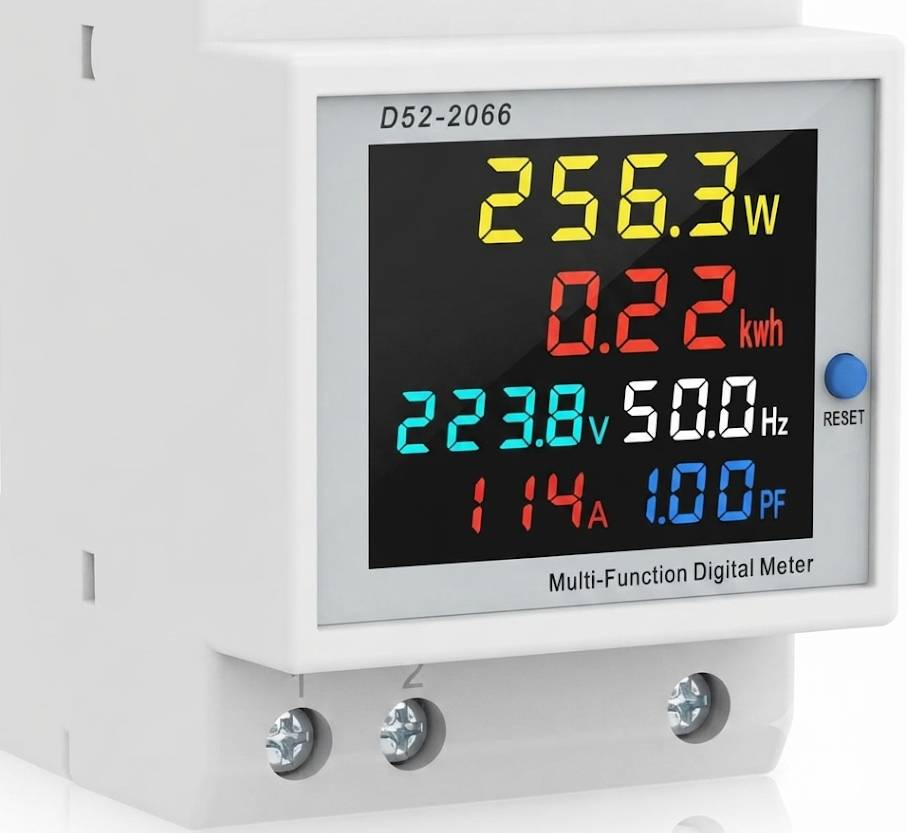
A digital energy meter is an electronic instrument that measures electrical energy using voltage and current sensing circuits, electronic signal processing, and a digital computing system.
Unlike an electromechanical meter, it does not require a rotating disc or mechanical register.
Working Principle of Digital Energy Meter
The meter senses the voltage and current of the electrical circuit.
Depending on the meter design, current may be measured using a current transformer, shunt, Hall-effect sensor, or another sensing method. The voltage is measured using an appropriate voltage-sensing circuit.
The electronic measuring circuit processes these signals and calculates real power.
The instantaneous power is:
The meter then integrates the power over time:
The calculated energy is stored electronically and displayed on an LCD, LED, or other digital display.
Parameters Measured by Digital Energy Meters
Modern digital energy meters can provide much more information than simply cumulative kWh.
Depending on the model, they may measure:
| Parameter | Unit |
| Active energy | kWh |
| Reactive energy | kVArh |
| Apparent energy | kVAh |
| Voltage | V |
| Current | A |
| Active power | kW |
| Reactive power | kVAr |
| Apparent power | kVA |
| Power factor | — |
| Frequency | Hz |
| Maximum demand | kW or kVA |
Not all digital meters provide every parameter listed above. The available functions depend on the meter design and application.
Features of Digital Energy Meters
Important features include:
- Digital display for easy reading
- No rotating mechanical disc
- Electronic measurement of energy
- High measurement capability and repeatability
- Measurement of additional electrical parameters
- Electronic data storage
- Compact construction
- Communication capability in many models
- Availability of pulse outputs for energy monitoring
Digital meters are widely used in industrial panels, commercial buildings, substations, and residential installations.
Smart Energy Meter
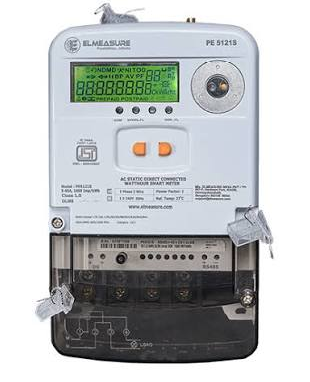
A smart energy meter is an advanced electronic energy meter that combines electrical energy measurement with data storage, communication, remote monitoring, and other intelligent functions.
Smart meters form an important part of Advanced Metering Infrastructure (AMI) and modern smart-grid systems.
Working Principle of Smart Energy Meter
The basic energy measurement process is similar to that of a digital energy meter. Voltage and current are electronically sensed and processed to determine electrical power and accumulated energy.
The additional capability comes from the meter’s communication and data-processing systems.
A smart meter can periodically record energy consumption and transmit the information to a remote utility or energy-management system.
Depending on its design, communication may be provided through cellular networks, RF communication, power-line communication (PLC), or other communication technologies.
Features of Smart Energy Meters
Smart energy meters can provide several advanced functions, such as:
- Remote meter reading
- Two-way communication
- Interval energy recording
- Load-profile storage
- Maximum-demand recording
- Tamper and event detection
- Power interruption and restoration records
- Remote monitoring
- Time-of-use measurement
- Prepaid metering support
- Import and export energy measurement
- Integration with utility management systems
Advantages of Smart Energy Meters
Smart meters reduce the need for manual meter reading and allow utilities to obtain consumption information remotely.
They can also help consumers understand when and how electricity is being consumed. This information can support energy conservation and demand-management activities.
For utilities, smart metering can improve data collection, billing processes, outage information, and distribution-system management.
Single-Phase Energy Meter
A single-phase energy meter is designed for measuring electrical energy in a single-phase AC supply.
It is commonly used in:
- Residential buildings
- Small shops
- Offices
- Small commercial installations
- Low-power electrical loads
For a single-phase AC circuit, real power is:
The meter measures the voltage and current and determines the real energy consumed by the connected load.
Three-Phase Energy Meter
A three-phase energy meter is used in three-phase electrical systems and is widely used for industrial and commercial applications.
Three-phase meters are commonly available for:
- Three-phase, three-wire systems
- Three-phase, four-wire systems
For a balanced three-phase load:
where:
- = line voltage
- = line current
- = power factor
Three-phase energy meters may be directly connected for lower-current applications or connected through CTs and PTs for higher-current and higher-voltage systems.
Three-Phase, Three-Wire Energy Meter
A three-phase, three-wire energy meter is used in a three-phase system having three phase conductors and no neutral conductor.
Such meters are commonly used for three-phase industrial loads and other three-wire electrical systems.
Power measurement in a three-wire system can be based on the two-element or two-wattmeter principle.
If the two measured power components are and :
This principle allows total three-phase active power to be measured without a neutral conductor.
Three-Phase, Four-Wire Energy Meter
A three-phase, four-wire energy meter is designed for systems having three phase conductors and one neutral conductor.
It is commonly used where both three-phase and single-phase loads are connected to the same electrical system.
The meter can measure the energy associated with the individual phase circuits and determine the total energy consumption.
These meters are commonly used in commercial buildings, industries, distribution systems, and other installations where a neutral conductor is available.
Direct-Connected Energy Meter
In a direct-connected energy meter, the load current flows directly through the current circuit of the meter.
This arrangement is generally used for relatively low-current applications where the current is within the meter’s specified direct-connected rating.
For example, a meter may have markings such as:
The exact meaning depends on the applicable meter standard, but it commonly indicates a basic current of 10 A and a maximum current of 60 A.
CT-Operated Energy Meter
For high-current electrical installations, the load current is normally too high to pass directly through the meter.
In such cases, a current transformer (CT) is used.
For example, consider a CT rated:
This means that a primary current of 400 A corresponds to a secondary current of 5 A at the rated operating condition.
The energy meter measures the CT secondary current and uses the programmed CT ratio to determine the corresponding primary-side electrical quantities.
CT-operated meters are commonly used in:
- Industrial plants
- Large commercial buildings
- Motor control centers
- Main incoming panels
- Distribution substations
- High-current feeders
Correct CT polarity and ratio are essential for accurate measurement.
CT and PT Operated Energy Meter
In high-voltage metering systems, both current transformers (CTs) and potential transformers (PTs) or voltage transformers may be used.
The CT reduces the current to a suitable meter input, while the PT reduces the system voltage to a suitable measurement level.
For example:
and:
The corresponding ratios are:
Thus, where the meter configuration uses the full transformer ratios as a multiplication factor:
The actual meter programming and multiplication method must match the manufacturer’s instructions and the complete metering arrangement.
Import and Export Energy Meter
Modern electronic meters can measure energy flow in both directions. In this context, import energy refers to the energy received from the utility or electrical grid. Conversely, export energy is the energy supplied from the consumer’s installation back to the grid.
Bidirectional metering is particularly important for:
- Solar power systems
- Grid-connected renewable-energy systems
- Battery energy storage systems
- Cogeneration plants
- Captive generation
For example, a solar installation may consume electricity from the grid during periods of low solar generation and export surplus electricity when generation exceeds local demand.
Prepaid Energy Meter
A prepaid energy meter allows electricity consumption to be associated with a prepaid credit or balance.
The consumer purchases or adds credit to the metering system, and the available balance decreases according to energy consumption.
Prepaid metering can help consumers monitor their electricity usage and provides utilities with an alternative to conventional postpaid billing.
Depending on the system, the meter may provide warnings when the available balance becomes low and may control supply when the credit is exhausted.
Energy Meter Accuracy Class
The accuracy class of an energy meter indicates its measurement performance under specified test conditions and according to the applicable standard.
Common accuracy-class designations include:
- Class 0.2
- Class 0.5
- Class 1
- Class 2
A lower numerical class designation generally indicates a more stringent accuracy requirement.
The required accuracy depends on the application. Billing and revenue metering generally require higher accuracy than basic energy-monitoring applications.
The accuracy of the complete metering system can also be affected by CTs, PTs, wiring, installation conditions, and instrument configuration.
What Is Calibration of an Energy Meter?
Calibration is the process of comparing an energy meter’s measurement with a suitable reference standard under specified test conditions.
During calibration, known electrical conditions are applied and the meter’s registration is compared with the reference value.
The percentage error can be calculated as:
For example, if the reference energy is 100 kWh and the meter registers 100.5 kWh:
The permissible error depends on the meter’s accuracy class and the applicable standard.
What Is the Energy Meter Constant?
The energy meter constant represents the relationship between electrical energy and the meter’s output.
For an electromechanical meter, the constant may be expressed in revolutions per kWh.
where:
- = meter constant
- = number of disc revolutions
- = energy in kWh
Electronic meters may instead specify a pulse constant, such as:
This means that 1,000 output pulses correspond to 1 kWh under the specified meter configuration.
The meter constant is useful during testing and calibration.
What Are Ib and Imax in an Energy Meter?
Ib and Imax are important current ratings found on many direct-connected energy meters.
Basic Current (Ib)
Ib, or basic current, is the reference current used for specifying the performance characteristics of the meter.
It is not the maximum current that the meter can carry.
Maximum Current (Imax)
Imax is the maximum current for which the meter is designed to operate under its specified conditions.
For example, a meter marked:
may have:
The exact interpretation of markings should be verified against the relevant meter standard and manufacturer’s datasheet.
Applications of Energy Meters
Energy meters are used in almost every part of the electrical power system.
Common applications include:
- Residential energy measurement
- Commercial electricity billing
- Industrial energy monitoring
- Substation metering
- Feeder energy measurement
- Motor-load monitoring
- Energy audits
- Power-generation measurement
- Solar power systems
- Renewable-energy installations
- Building energy-management systems
- Demand monitoring
- Utility revenue metering
Industries can also use multiple meters to monitor individual departments, production lines, motors, compressors, pumps, and other major electrical loads.
Advantages of Energy Meters
Energy meters provide several important benefits to both consumers and electricity suppliers.
- They provide a quantitative measurement of electrical energy.
- They support electricity billing.
- They help identify energy consumption patterns.
- Digital meters can provide additional electrical parameters.
- Smart meters allow remote data collection.
- Energy monitoring helps identify excessive consumption.
- Industrial meters can support energy-management programs.
- Bidirectional meters can measure import and export energy.
- Modern meters can store historical and event data.
- Communication-enabled meters can integrate with monitoring systems.
Conclusion
An energy meter is an essential electrical instrument used to measure the amount of electrical energy consumed or supplied over time. Therefore, its basic measurement principle is based on determining electrical power and accumulating it over the operating period.
Electromechanical energy meters use electromagnetic induction and a rotating aluminium disc, while digital energy meters use electronic voltage and current sensing circuits. Smart energy meters extend this technology by adding communication, data storage, remote monitoring, and advanced metering functions.
Energy meters can also be classified according to the electrical system and connection method, including single-phase, three-phase three-wire, three-phase four-wire, direct-connected, CT-operated, and CT/PT-operated meters.
The selection of an energy meter depends on factors such as system voltage, current, number of phases, wiring configuration, accuracy requirement, CT/PT ratios, communication requirements, and the intended application.
Understanding the types of energy meters, their working principles, ratings, accuracy, calibration, meter constants, and connection methods is important for accurate electrical energy measurement and effective energy management.
FAQs Based on Energy Meters
An energy meter is an electrical instrument used to measure the amount of electrical energy consumed or supplied over a specified period. The most common billing unit is kWh.
Based on technology, the main types are electromechanical, digital/electronic, and smart energy meters.
t works on electromagnetic induction. Magnetic fluxes produced by the voltage and current coils create torque that rotates an aluminium disc. The number of revolutions is proportional to the electrical energy consumed.
A digital meter senses voltage and current electronically, calculates real power, and integrates power with time to determine energy.
It defines the relationship between the meter’s output and measured energy, such as disc revolutions per kWh or pulses per kWh.
Read Next: