An ammeter shunt is an important component used to extend the current-measuring range of an ammeter. It provides a low-resistance path connected in parallel with the meter movement, allowing most of the circuit current to bypass the sensitive measuring coil.
A shunt resistor makes it possible to measure currents much higher than the rated current of the basic ammeter movement. It is widely used in DC ammeters, digital panel meters, battery monitoring systems, and electrical testing equipment.
What Is an Ammeter Shunt?
An ammeter shunt is a precision low-resistance resistor connected in parallel with an ammeter or its measuring element to extend the current-measuring range.
An ordinary ammeter movement is designed to carry only a small current. If a large current passes directly through its coil, excessive heating can damage the winding and measuring mechanism.
The shunt provides an alternative path for the major portion of the current. Only the rated current flows through the meter movement, while the remaining current passes through the shunt resistor.
An ammeter shunt may be built inside the instrument or connected externally, depending on the current rating and instrument design.
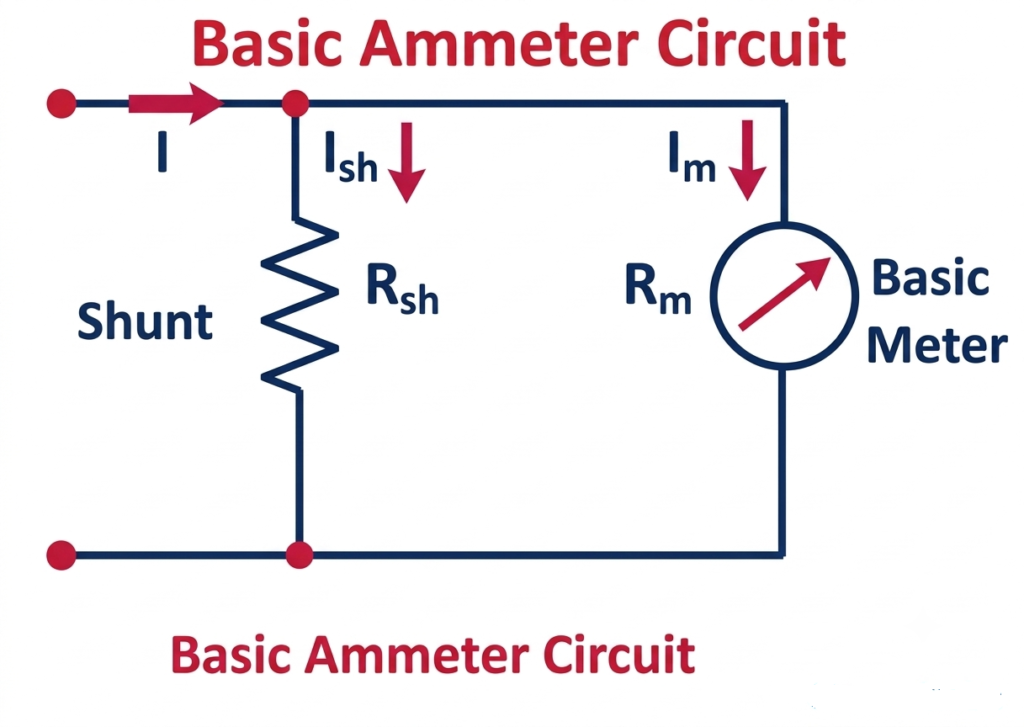
Why Is a Shunt Connected in Parallel with an Ammeter?
A shunt is connected in parallel because a parallel connection provides the same voltage across both the meter movement and the shunt resistor.
The resistance of the shunt is much lower than the resistance of the measuring movement. Therefore, most of the total current flows through the shunt, while only a small, safe current passes through the meter coil.
This arrangement offers several benefits:
- Protects the meter movement: It prevents excessive current from flowing through the sensitive coil.
- Extends the measuring range: It allows a low-current movement to measure much higher currents.
- Maintains accurate measurement: The meter movement carries its specified full-scale current.
- Reduces power dissipation in the movement: Most of the current flows through the low-resistance shunt.
A shunt is therefore connected in parallel, not in series, with the ammeter movement.
Working Principle of an Ammeter Shunt
The working principle of an ammeter shunt is based on the current division rule.
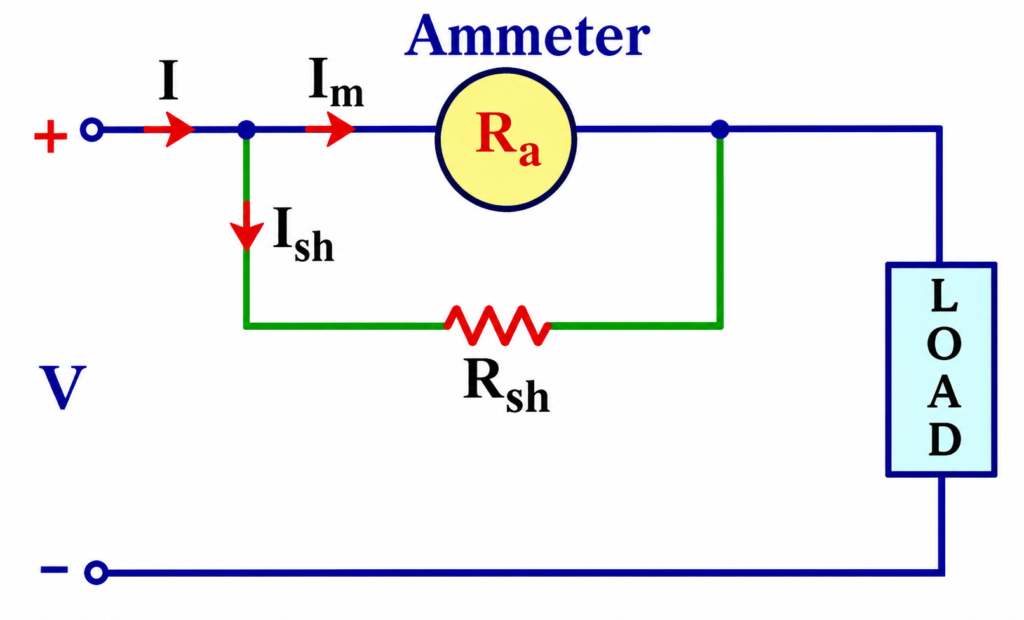
When a shunt resistor is connected in parallel with the ammeter movement, the incoming current divides into two paths:
- Meter current flows through the ammeter movement.
- Shunt current flows through the shunt resistor.
The total current entering the parallel combination is:
Since the two branches are connected in parallel, the voltage across them is equal:
Where:
- = Total current being measured
- = Current flowing through the meter movement
- = Current flowing through the shunt
- = Resistance of the meter movement
- = Resistance of the shunt
The shunt carries the major portion of the current because its resistance is much lower than the meter resistance.
Ammeter Shunt Resistance Formula and Calculation
The shunt resistance is calculated using the current flowing through the meter movement and the current that must pass through the shunt.
From the parallel circuit:
Therefore:
Since the total current is:
The shunt current is:
Substituting this value gives the required shunt resistance:
This is the standard formula used to calculate the resistance of an ammeter shunt.
Example: Calculate Ammeter Shunt Resistance
A moving coil ammeter has a resistance of 100 Ω and a full-scale deflection current of 1 mA. Calculate the shunt resistance required to extend its measuring range to 10 A.
Given:
- Meter resistance,
- Meter full-scale current,
- Desired ammeter current,
Using the shunt resistance formula:
Substituting the values:
Therefore, a shunt resistance of approximately 0.01 Ω is required to extend the ammeter range to 10 A.
The meter movement carries only 1 mA at full-scale deflection, while the shunt carries approximately 9.999 A.
Multiplying Factor of an Ammeter Shunt
The multiplying factor indicates how many times the total current range of an ammeter is greater than the full-scale current of its meter movement.
It is calculated as:
Where:
- = Multiplying factor
- = Desired full-scale current of the ammeter
- = Full-scale current of the meter movement
The shunt resistance can also be expressed in terms of the multiplying factor.
We know that:
Dividing the numerator and denominator by :
This equation is useful when the multiplying factor and meter resistance are known.
For example: If the multiplying factor is 100 and the ammeter resistance is 10 Ω:
Construction and Material Requirements of an Ammeter Shunt
An ammeter shunt is generally made from a low-resistance metallic strip or a precision resistance element. It must carry the bypass current without excessive heating or significant changes in resistance.
The following properties are important when selecting a shunt material.
1. Low Temperature Coefficient of Resistance
The resistance should remain nearly constant when the shunt temperature changes. A low temperature coefficient helps maintain measurement accuracy under varying load conditions.
2. Stable Resistance
The material should have good long-term resistance stability. Its resistance should not change significantly due to ageing, oxidation, or normal operating conditions.
3. Low Resistivity and Adequate Current Capacity
The shunt must provide a sufficiently low resistance while carrying the required current safely. Its dimensions should be selected to withstand the associated heat and electrical loading.
4. Low Thermoelectric EMF
A suitable shunt material should minimise unwanted thermoelectric voltage at connections with copper conductors. This is particularly important in precision low-voltage measurements.
5. Low Inductance
For AC measurement, the shunt should have low and controlled inductance. Excessive inductance can affect the current distribution and introduce measurement errors, particularly at higher frequencies.
Common Materials Used for Ammeter Shunts
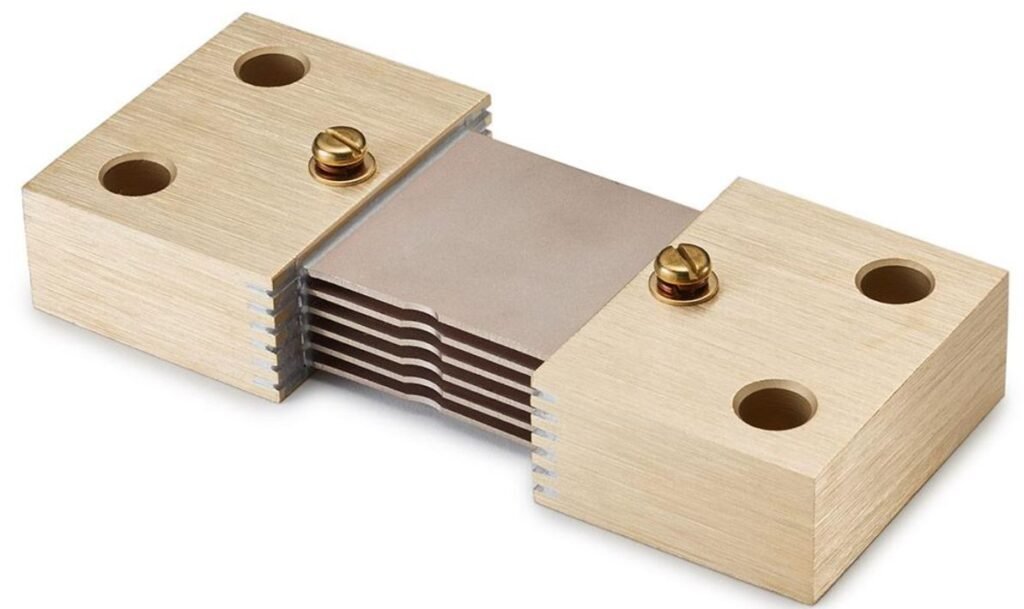
Manganin is widely used for precision shunts because it offers low temperature coefficient, good resistance stability, and low thermoelectric EMF against copper.
Constantan is another resistance alloy used in certain measuring applications. The material selection depends on the required accuracy, temperature conditions, current rating, and AC or DC application.
Types of Ammeter Shunts
Ammeter shunts can be classified according to their construction and installation.
1. Internal Shunt
An internal shunt is built inside the ammeter. It is generally used in instruments having relatively lower or moderate current ranges, depending on the instrument design.
The shunt and meter movement are assembled as a single unit, making the instrument convenient to install and operate.
2. External Shunt
An external shunt is installed separately from the measuring instrument. It is commonly used for measuring high currents where the shunt must carry a substantial portion of the circuit current.
The shunt is connected in series with the main current-carrying circuit, while the measuring instrument is connected across its designated voltage-sensing terminals.
3. Four-Terminal Shunt
A four-terminal shunt has two heavy current terminals and two separate voltage-sensing terminals.
The current terminals carry the load current, while the voltage terminals measure the small voltage drop across the calibrated resistance element.
This arrangement reduces the effect of contact and lead resistance on the measurement and improves accuracy.
Applications of Ammeter Shunts
Ammeter shunts are used wherever electrical current exceeds the direct measuring capacity of the instrument.
Common applications include:
- DC ammeters: Extending the current range of moving coil instruments.
- Battery monitoring: Measuring charging and discharging current in battery systems.
- Power supplies: Monitoring current in DC power supply circuits.
- Electrical panels: Measuring current in industrial distribution and control panels.
- Automotive systems: Measuring battery and alternator current.
- Industrial equipment: Monitoring current in DC drives, rectifiers, and other electrical equipment.
- Digital panel meters: Providing a proportional voltage signal for current measurement and display.
- Energy monitoring systems: Measuring current in electrical testing and monitoring applications.
Difference Between Ammeter and Ammeter Shunt
| Parameter | Ammeter | Ammeter Shunt |
| Function | Measures electric current | Extends the current range |
| Resistance | Generally low | Extremely low |
| Connection | In series with the circuit | In parallel with the meter movement |
| Current | Carries the movement’s rated current | Carries most of the current being measured |
| Construction | Measuring movement or electronic circuit | Precision low-resistance element |
| Main purpose | Indicates current | Protects the movement and enables higher-current measurement |
Conclusion
An ammeter shunt is an essential component for measuring currents higher than the rated capacity of a conventional ammeter movement. It works by providing a low-resistance parallel path that carries most of the current while allowing only a small, specified current to flow through the meter movement.
The correct selection of shunt resistance, material, current rating, and temperature characteristics is important for accurate and reliable measurements. Manganin shunts are widely used in precision current-measuring applications because of their stable resistance and low temperature coefficient.
Read Next:
- Ammeter: Definition, Symbol, Working Principle, Types and Applications
- Clamp Meter Working Principle, Diagram & Uses
- Difference Between Indicating and Recording Instruments
- Null Type Instrument: Principle, Example, and Key Advantages
- Types of Measuring Instruments in Electrical Engineering
- Integrating Instruments: Classifications, Advantage and Applications
- Digital Instruments: Definition, Characteristics, Construction, Advantages, and Disadvantages
- Analog Instruments: Definition, Classification, and Working Principle