Understanding the table of electrical resistivity and conductivity is essential for students, engineers, and anyone working with electrical systems. These values help determine how well a material allows electric current to flow and are widely used in designing wires, circuits, and electronic components.
What is Electrical Resistivity?
Electrical resistivity (ρ) is a property that tells us how strongly a material resists the flow of electric current. It is measured in ohm-meters (Ω·m).
- Low resistivity → material allows current to pass easily
- High resistivity → material resists current flow
For example, the resistivity of copper is very low, making it one of the best conductors used in electrical wiring.
What is Electrical Conductivity?
Electrical conductivity (σ) is the opposite of resistivity. It measures how well a material conducts electricity and is expressed in siemens per meter (S/m).
- Conductivity is the reciprocal of resistivity
- Formula: σ = 1 / ρ
An example of conductivity is copper, which has extremely high conductivity compared to most materials.
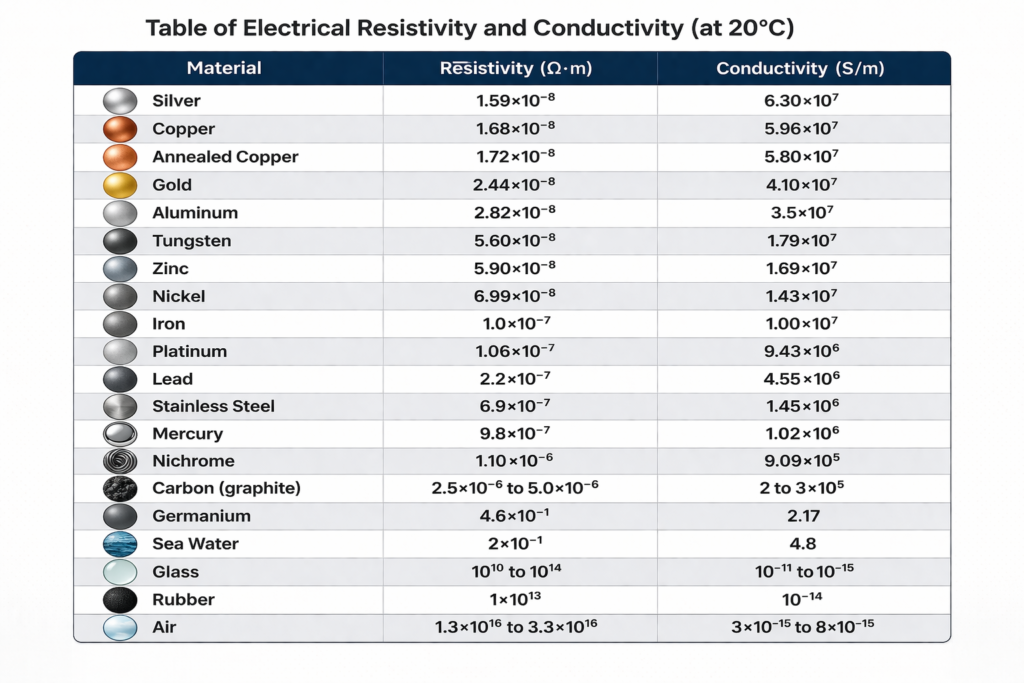
Table of Electrical Resistivity and Conductivity (at 20°C)
Below is a refined and structured table showing important materials and their values:
| Material | Resistivity (Ω·m) | Conductivity (S/m) |
| Silver | 1.59×10⁻⁸ | 6.30×10⁷ |
| Copper | 1.68×10⁻⁸ | 5.96×10⁷ |
| Annealed Copper | 1.72×10⁻⁸ | 5.80×10⁷ |
| Gold | 2.44×10⁻⁸ | 4.10×10⁷ |
| Aluminum | 2.82×10⁻⁸ | 3.5×10⁷ |
| Tungsten | 5.60×10⁻⁸ | 1.79×10⁷ |
| Zinc | 5.90×10⁻⁸ | 1.69×10⁷ |
| Nickel | 6.99×10⁻⁸ | 1.43×10⁷ |
| Iron | 1.0×10⁻⁷ | 1.00×10⁷ |
| Platinum | 1.06×10⁻⁷ | 9.43×10⁶ |
| Lead | 2.2×10⁻⁷ | 4.55×10⁶ |
| Stainless Steel | 6.9×10⁻⁷ | 1.45×10⁶ |
| Mercury | 9.8×10⁻⁷ | 1.02×10⁶ |
| Nichrome | 1.10×10⁻⁶ | 9.09×10⁵ |
| Carbon (graphite) | 2.5×10⁻⁶ to 5.0×10⁻⁶ | 2 to 3×10⁵ |
| Germanium | 4.6×10⁻¹ | 2.17 |
| Sea Water | 2×10⁻¹ | 4.8 |
| Glass | 10¹⁰ to 10¹⁴ | 10⁻¹¹ to 10⁻¹⁵ |
| Rubber | 1×10¹³ | 10⁻¹⁴ |
| Air | 1.3×10¹⁶ to 3.3×10¹⁶ | 3×10⁻¹⁵ to 8×10⁻¹⁵ |
Focus on Copper Conductivity
Copper is one of the most widely used conductive materials. Let’s highlight its importance using key search terms:
- Conductivity of copper: ~5.96×10⁷ S/m
- Electrical conductivity copper is second only to silver
- Copper conductivity remains stable and reliable
- Cu conductivity is ideal for wiring and cables
- Electrical conductivity for copper makes it perfect for power transmission
- Conductivity for copper is why it dominates electrical industries
Because of its balance of cost, durability, and performance, conductivity copper properties make it the preferred choice over silver in most applications.
What Affects Electrical Conductivity?
Three main factors determine how well a material conducts electricity:
1. Cross-Sectional Area
A thicker conductor allows more electric current to pass through it easily, which lowers resistance. A thinner wire, on the other hand, restricts the flow of current.
2. Length of the Conductor
Short conductors offer less resistance, so electricity flows more easily. As the length increases, resistance also increases because the current has to travel a longer distance.
3. Temperature
Temperature plays a big role in conductivity. When temperature increases, atoms vibrate more and disturb the flow of electrons, reducing conductivity. At lower temperatures, conductivity improves. In extremely cold conditions, some materials can even become superconductors with almost zero resistance.
Most Conductive Material
- Silver has the highest conductivity of all elements
- Copper is the most practical and widely used
- Gold is used where corrosion resistance is critical
Key Takeaways
- Electrical resistivity and conductivity are fundamental properties of materials
- Materials like copper have low resistivity and high conductivity
- The resistivity of copper makes it ideal for electrical wiring
- Factors like temperature, length, and area significantly impact performance
- The provided table helps compare materials for real-world applications
Read Next: