The resistivity of copper is a key electrical property that indicates how strongly it opposes electric current. Due to its low resistivity, it is widely used in wiring, motors, transformers, and electronic components.
This article covers the copper’s resistivity, its temperature-dependent values, formula, and a detailed temperature table.
What is Resistivity?
Resistivity (ρ) measures how much a material resists current flow and is expressed in ohm-meters (Ω·m). It depends on factors like temperature and the material’s internal structure, and it helps determine how suitable a material is for electrical wiring and electronic components.
Resistivity of Copper Formula
The relationship between resistance, length, and cross-sectional area of a conductor is used to determine its resistivity, which is a fundamental property of the material.
ρ=R⋅A/L
Where:
- ρ = resistivity (Ω·m)
- R = resistance (Ω)
- A = cross-sectional area (m²)
- L = length (m)
Resistivity of Copper at Different Temperatures
The electrical resistance of copper rises as the temperature increases. Key values for the resistivity of copper wire include:
- At 20°C (typical for copper wires): 1.68 × 10⁻⁸ Ω·m
- At room temperature (25°C): 1.72 × 10⁻⁸ Ω·m
- At 75°C (typical for copper wires under load): 2.10 × 10⁻⁸ Ω·m
These values are essential for practical applications such as cable sizing, circuit design, and thermal analysis.
Copper Resistivity by Temperature
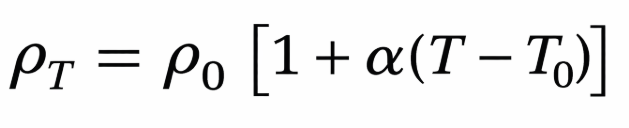
The variation with temperature is given by:
Where:
- ρ₀ = resistivity at reference temperature (20°C)
- α Temperature Coefficient ≈ 0.00393/°C
- T = final temperature
Copper Resistivity vs Temperature Table
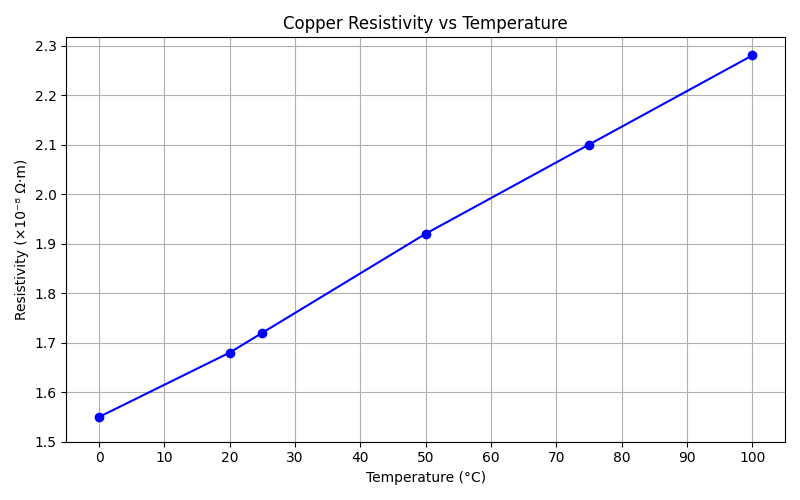
Resistivity increases when the temperature rises because electrons collide more frequently with atoms in the material. At lower temperatures, these collisions reduce, causing the resistivity to decrease significantly. The following table shows effect of temperature on resistivity.
| Temperature (°C) | Resistivity (×10⁻⁸ Ω·m) |
|---|---|
| 0 | 1.55 |
| 20 | 1.68 |
| 25 | 1.72 |
| 50 | 1.92 |
| 75 | 2.10 |
| 100 | 2.28 |
How Temperature Affects Copper Losses
Even if the current through a copper conductor stays the same, higher ambient temperatures increase copper losses. This happens because copper’s resistance rises with temperature — a property known as a positive temperature coefficient.
The Mechanism:
- More collisions: As the copper heats, its atoms vibrate faster, scattering electrons more often and increasing resistance.
- Higher power loss: With current constant, higher resistance directly leads to more energy wasted as heat, calculated by the formula P=I2R.
- Real-world impact: Resistance grows about 0.39–0.4% per °C. For example, motor windings can experience nearly 50% more loss when temperature climbs from 20°C to 160°C.
Consequences:
- Larger voltage drops along conductors
- Reduced efficiency due to extra heat
- Need for cable derating in hotter environments to prevent insulation damage
Resistivity Material Chart
The resistivity material chart provides a clear overview of the resistivity values of different materials. These values are important for understanding how materials behave electrically and determining their suitability for various applications. The following table shows the resistivity of some key materials.
| Material | Resistivity (Ω·m) |
|---|---|
| Silver | 1.59 × 10⁻⁸ |
| Copper | 1.68 × 10⁻⁸ |
| Gold | 2.44 × 10⁻⁸ |
| Aluminum | 2.82 × 10⁻⁸ |
| Iron | 1.0 × 10⁻⁷ |
| Nichrome | 1.1 × 10⁻⁶ |
Copper offers an excellent balance of conductivity, cost, and durability.
Why Copper is Preferred
- Low resistivity (high conductivity)
- Ductile and easy to shape
- Good thermal conductivity
- Corrosion resistant
Key Takeaways
- Copper has low electrical resistivity, increasing with temperature.
- At 20°C, its resistivity is 1.68 × 10⁻⁸ Ω·m; at 75°C, it rises to 2.10 × 10⁻⁸ Ω·m.
- Temperature tables help in precise calculations.
- Copper remains one of the most efficient conductors
Read Next: