Understanding the difference between resistivity and conductivity is essential in physics and electrical engineering. These two properties describe how materials respond to electric current, but they are opposites of each other.
Understanding Resistivity and Conductivity
Electrical Resistivity
Electrical resistivity is a property that indicates how much a material resists the flow of electric current. Often referred to as “specific resistance,” it allows different materials to be compared based on their inherent characteristics at a given temperature, independent of their size or shape. In simple terms, a higher resistivity (ρ) means greater opposition to current flow, while a lower value indicates that current can pass through more easily.
For instance, a highly conductive material like copper has a very low resistivity, around 1.72×10⁻⁸ ohm metre (17.2 nΩm). In contrast, insulating materials such as air have extremely high resistivity values, often exceeding 1.5×10¹⁴ ohm metre. This vast difference explains why some materials are suitable for conducting electricity, while others are not.
Metals like copper and aluminium are widely used in electrical wiring because their low resistivity allows current to flow efficiently. Although silver and gold have even lower resistivity, their high cost limits their practical use in everyday electrical applications.
The resistance (R) of a conductor depends on several key factors:
- The resistivity (ρ) of the material
- The length (L) of the conductor
- The cross-sectional area (A) of the conductor
- The temperature of the conductor
Electrical Conductivity
Conductivity is the measure of how easily electric current flows through a material. A higher conductivity means better current flow.
Although electrical resistance (R) and resistivity (ρ) both depend on the material’s nature as well as its dimensions—such as length (L) and cross-sectional area (A)—conductivity focuses on how easily electric current can pass through that material.
Conductance (G) is the inverse of resistance, expressed as G=1/R. Its unit is the siemens (S), sometimes represented by the symbol ℧ (mho). This means that a conductor with a conductance of 1 siemens has a resistance of 1 ohm. If the resistance increases, the conductance decreases proportionally, and vice versa. In simple terms:
- siemens = 1/ohms
- ohms = 1/siemens
Resistance measures how strongly a material opposes current flow, whereas conductance indicates how easily current can move through it. Materials like copper, aluminium, and silver have high conductance values, making them excellent conductors of electricity.
Electrical conductivity, denoted by σ (sigma), is the reciprocal of resistivity:σ=1/ρ
It is measured in siemens per metre (S/m). Since conductivity is the inverse of resistivity, the formula for resistance can also be rewritten in terms of conductivity.
Resistivity and Conductivity Formula
Resistivity Formula:
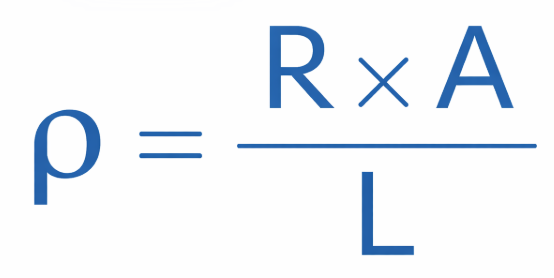
Where:
- ρ: Electrical resistivity in ohm-meter (Ω·m)
- R: Resistance in ohms (Ω)
- A: Cross-sectional area in square meters (m²)
- L: Length of the conductor in meters (m)
Conductivity Formula:
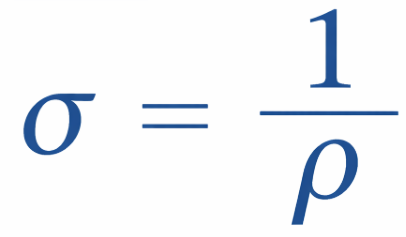
Where:
- σ (sigma) = electrical conductivity (measured in siemens per metre, S/m)
- ρ (rho) = electrical resistivity (measured in ohm metre, Ω·m)
Another related form using resistance is:
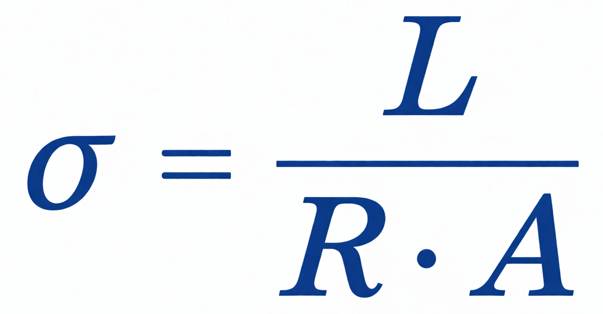
Where:
- R = resistance
- L = length of the conductor
- A = cross-sectional area
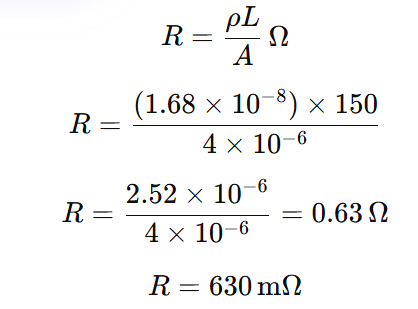
Resistivity Example No1
Find the total DC resistance of a 150 metre length of 4 mm² copper wire, given that the resistivity of copper at 20°C is 1.68×10⁻⁸ Ω·m.
Data given:
Resistivity of copper at 20∘C, ρ=1.68×10⁻⁸Ωm
Length of wire, L=150m
Cross-sectional area, A=4mm2=4×10⁻⁶m2
Conductivity Example No2
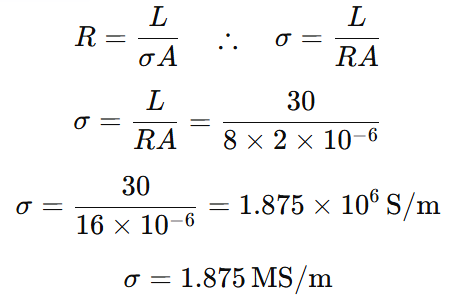
A wire of 30 metres in length has a cross-sectional area of 2 mm² and a resistance of 8 ohms. Determine the electrical conductivity of the wire.
Data given:
DC resistance, R=8 ohms
Cable length, L=30 m
Cross-sectional area, A=2 mm2=2×10⁻⁶ m2
Relationship Between Resistivity and Conductivity
Resistivity and conductivity are mathematically related as:
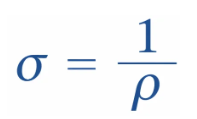
This means:
- If resistivity increases, conductivity decreases
- If resistivity decreases, conductivity increases
Thus, there is inverse relationship between resistivity and conductivity.
Resistivity and Conductivity Unit
- Resistivity Unit: Ohm-meter (Ω·m)
- Conductivity Unit: Siemens per meter (S/m)
Resistivity vs Conductivity: Tabular Comaprision
| Property | Resistivity (ρ) | Conductivity (σ) |
| Meaning | Opposes current flow | Allows current flow |
| Nature | Intrinsic property | Intrinsic property |
| Relation | Inverse of conductivity | Inverse of resistivity |
| Unit | Ohm-meter (Ω·m) | Siemens per meter (S/m) |
| Formula | ρ = RA / L | σ = 1 / ρ |
Factors Affecting Conductivity and Resistivity
Several factors influence conductivity and resistivity, determining how easily electric current flows through a material:
1. Temperature
Temperature significantly affects electrical behavior. In conductors, resistivity increases with rising temperature due to increased atomic vibrations, while in semiconductors, resistivity decreases as temperature rises, improving conductivity.
2. Material Type
The nature of the material plays a crucial role. Metals generally have high conductivity, insulators exhibit high resistivity, and semiconductors show intermediate behavior that can vary with conditions.
3. Impurities
The presence of impurities or doping can alter electrical properties. In metals, impurities usually increase resistivity, whereas in semiconductors, controlled addition of impurities can enhance conductivity.
4. Physical Structure and Dimensions
Crystal structure, defects, and mechanical stress affect electron movement and can increase resistivity. Additionally, physical dimensions matter—longer materials increase resistance, while a larger cross-sectional area improves conductivity.
5. Ionic Concentration (for Liquids)
In liquid conductors, conductivity depends on the number of ions present. Higher ionic concentration leads to better conductivity.
Resistivity and Conductivity of Conductor, Semiconductor and Insulator
The resistivity and conductivity of conductors, semiconductors, and insulators determine how effectively they allow electric current to flow. Each material type has distinct electrical properties, making them suitable for different applications.
| Material Type | Resistivity | Conductivity | Application |
| Conductor (e.g., Copper, Silver) | Very low | Very high | Electrical wiring, cables, circuits |
| Semiconductor (e.g., Silicon, Germanium) | Moderate | Moderate | Microchips, LEDs, solar panels |
| Insulator (e.g., Glass, Rubber) | Very high | Very low | Electrical insulation, protective coverings |
These differences are important in selecting the right material for electrical and electronic systems, ensuring efficiency, safety, and proper performance.
Semiconductors show unique electrical characteristics. Their conductivity increases with temperature, and it can be further improved by doping (adding controlled impurities). Because of this, semiconductors are widely used in devices such as diodes, transistors, and integrated circuits.
These differences are important for choosing the right material in electrical and electronic applications, ensuring efficiency and reliability.
Conductivity to Resistivity Conversion Chart
The relationship between conductivity and resistivity is simple: resistivity (ρ) is the inverse of conductivity (σ), and conductivity is the inverse of resistivity.
| Conductivity (S/m) | Resistivity (Ω·m) |
| 1 | 1 |
| 10 | 0.1 |
| 100 | 0.01 |
| 1000 | 0.001 |
Measurement of Resistivity and Conductivity
Various measurement techniques are chosen based on the type of material being tested. For solid conductors, the four-point probe method is widely used because it provides accurate resistance measurements by minimizing contact resistance errors.
In the case of liquids, amperometric and potentiometric sensors are commonly employed to assess electrical behavior. These approaches are important for determining key material properties, detecting impurities, and ensuring the quality and consistency of the substance in practical applications.
Applications of Conductivity (Low Resistivity)
Electronics and Wiring:
Materials like copper and aluminum are used in wires, cables, and circuit boards because they allow electricity to flow easily.
Semiconductor Technology:
Silicon and germanium are used in devices like diodes, transistors, and microchips. Their conductivity can be carefully controlled.
Heating Devices:
Some materials are chosen to produce heat when current flows. These are used in appliances like heaters, toasters, and electric irons.
Environmental Monitoring:
Conductivity is used to check water quality. It helps detect dissolved salts, ions, and pollutants.
Applications of Resistivity (High Resistance Materials)
Electrical Insulation:
Materials such as rubber, glass, and plastics are used to stop unwanted current flow and prevent short circuits.
Water Purity Control:
Resistivity is used to test the purity of water, especially in industries like power plants and semiconductor manufacturing.
Geophysical Exploration:
Resistivity methods help study underground layers, find water sources, and locate minerals.
Material and Circuit Design:
Resistivity is important when designing components like resistors and potentiometers.
Overall, resistivity and conductivity are essential for building safe, efficient electrical systems and for many real-world applications.
Key Takeaways: Resistivity vs Conductivity
- Resistivity tells how much a material resists current
- Conductivity tells how easily current flows
- They are inversely related
- Both are essential for material selection in electrical systems
Conclusion
The difference between resistivity and conductivity lies in their opposite roles in current flow. While resistivity resists electricity, conductivity supports it. Understanding their relationship, formulas, units, and applications is crucial for studying electrical materials and designing efficient systems.
Read Next: