A bimetal is a specially engineered material formed by joining two different metals into a single structure. This combination allows it to exhibit multiple properties—such as strength, flexibility, and thermal responsiveness—that are not achievable with a single metal alone.
Bimetal-Definition and Meaning
A bimetal is created by permanently bonding two different metals so that they behave as a single unit while still maintaining their individual physical and chemical characteristics. Unlike alloys, where metals are mixed, each layer in a bimetal retains its identity.
The bimetal meaning lies in this unique combination, where two metals work together to deliver enhanced performance. Such materials are widely used in applications that require mechanical movement triggered by temperature changes.
In general, bimetallic refers to the strategic use of two metals to improve efficiency, particularly in thermal and structural systems.
A classic example is the bimetal strip definition, which describes a strip formed by bonding two metals with different rates of expansion. When heated, one expands more than the other, causing the strip to bend. This principle is widely used in temperature control and automatic switching devices.
Composition of Bimetal Element
When discussing what a bimetal element is composed of, it typically includes two metals with contrasting thermal expansion behaviors. One metal expands more (such as copper or brass), while the other expands less (such as steel or nickel alloys).
Common combinations in bimetallic strips include:
- Iron and nickel (iron expands more)
- Brass and steel (clear expansion difference)
- Copper and iron (stable thermal response)
- Constantan and Invar (high precision applications)
These combinations create strong layered materials widely used in engineering and industrial systems.
Key Properties of Bimetals
Bimetals are widely used because they respond accurately to temperature changes while maintaining strength and durability. Their effectiveness comes from a combination of thermal and mechanical properties:
- Differential Expansion Behavior
The most important property of bimetals is the difference in expansion of the two metals. When heated, one metal expands more than the other, causing the bonded strip to bend toward the side with lower expansion. - Temperature Sensitivity
The bending of a bimetal changes consistently with temperature variations. This predictable behavior makes it highly useful in temperature sensing and control systems. - Mechanical Strength and Flexibility
Bimetals are designed to offer both strength and flexibility. They can undergo repeated bending without damage, ensuring long-lasting performance. - Wide Operating Range
These materials can work efficiently across a wide temperature range, from very low to very high conditions, while maintaining stability. - Controlled Motion Capability
Depending on the design, bimetals can produce small deflections, rotational movement (such as in coils), or quick snap action used in switching devices.= - Resistance to Environmental Effects
Bimetals are often made to withstand moisture, chemicals, and harsh environmental conditions, ensuring reliable operation.
These properties make bimetallic material ideal for precision engineering and temperature-sensitive applications.
How Do Bimetals Work?
The working principle of a bimetal is based on the fact that different metals expand at different rates when exposed to temperature changes. This is explained by the coefficient of linear thermal expansion.
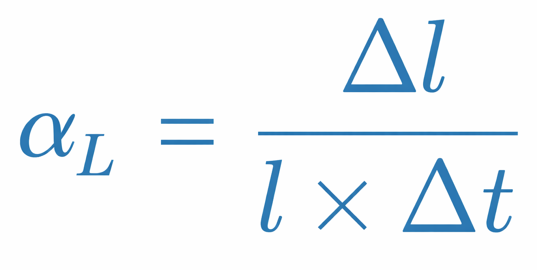
Where:
- αL = coefficient of linear thermal expansion
- l = original length
- Δl = change in length
- Δt = change in temperature
A typical bimetal consists of two bonded metal strips.
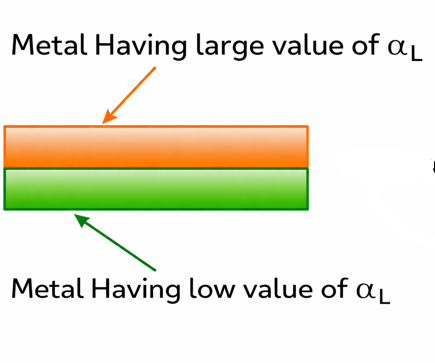
At room temperature, the strip stays flat and unchanged. When it is heated, the metal that expands more rapidly increases in length more than the other layer. Since the two metals are bonded together, this difference in expansion causes the strip to curve. The metal that expands more forms the outer side of the bend, while the one with less expansion becomes the inner side.
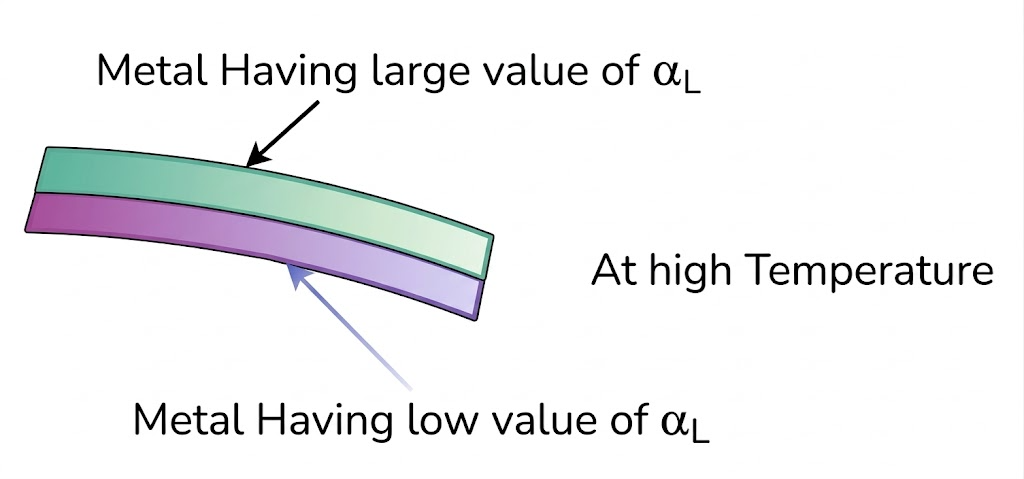
As the bimetallic strip loses heat, it bends into a curved, arc-like form. In this state, the metal with the lower linear expansion coefficient shifts to the outer side of the curve, while the metal with the higher expansion coefficient occupies the inner side, as shown in the figure below.
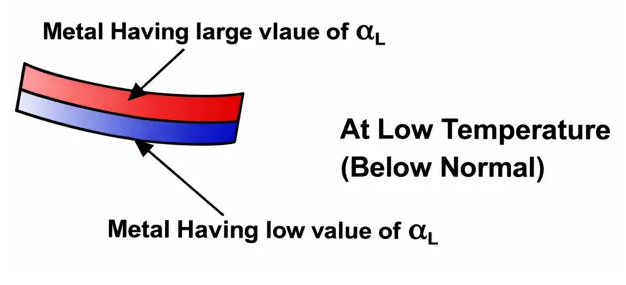
- At normal temperature → strip remains straight
- On heating → bends due to unequal expansion
- On cooling → returns or bends in the opposite direction
This simple mechanism allows bimetals to detect and control temperature without complex electronics.
Common Types of Bimetallic Strip Designs
Design selection plays a key role in performance. The most common bimetallic strip designs include:
- Disc Type – widely used, made from bonded metal discs
- Ribbon Type – flat strips joined along their length
- Coil Type – strips wound into spiral form
Each design offers unique advantages, and the choice depends on the intended application.
Applications of Bimetals
Bimetals are used across many industries due to their thermal sensitivity and mechanical reliability.
Bimetal Thermometers
Bimetallic strips are widely used in direct-reading thermometers and are often formed into a spiral or helical coil to increase sensitivity. In this configuration, one end of the coiled strip is securely fixed to the casing of the thermometer, while the other end is connected to a pointer that moves over a graduated scale. A typical design of such a thermometer is shown in the figure below.
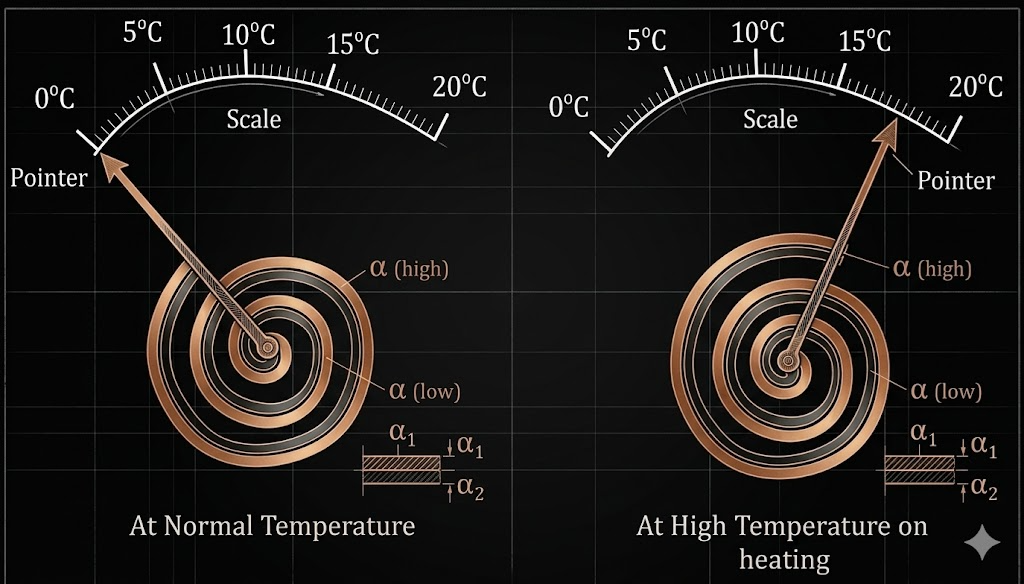
When the temperature changes, the two metals in the strip expand or contract at different rates. This unequal expansion causes the coil to tighten or unwind slightly, resulting in a twisting motion. As a result, the free end of the coil rotates, which in turn moves the attached pointer.
Because the scale is carefully calibrated in temperature units, the pointer’s position directly indicates the temperature. This simple yet effective mechanism allows bimetallic thermometers to provide quick and reliable readings without the need for external power.
Thermostat
Bimetallic strips play an important role in thermostats, where they are used to automatically control temperature in devices such as electric heaters, irons, refrigerators, and ovens. In certain designs, the heat needed for operation is produced by the electric current passing through the thermostat itself. A typical example of a bimetallic thermostat is shown in the figure below.
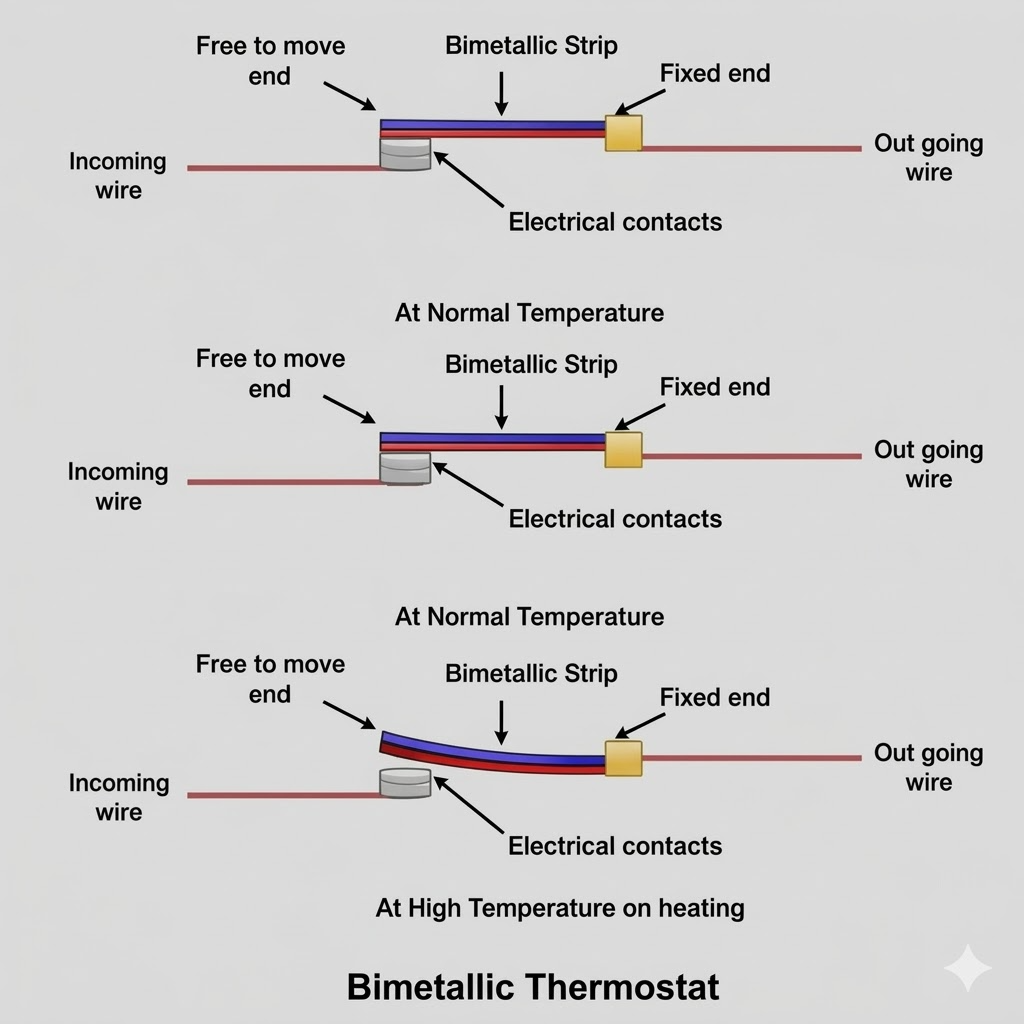
In this setup, one end of the bimetallic strip is fixed and connected to the power source, while the other end is free to move. A movable contact is attached to this free end, allowing it to shift as the strip bends in response to temperature changes.
At normal temperatures, the movable contact remains in touch with a fixed contact, keeping the electrical circuit complete. When the temperature increases, the strip bends due to unequal expansion of the two metals, causing the movable contact to move away from the fixed contact. This breaks (or in some designs, completes) the circuit, thereby regulating the flow of current.
As the temperature falls back to the desired level, the strip returns to its original shape. This restores the contact to its initial position, once again opening or closing the circuit as required, and maintaining a stable temperature automatically.
Protective Devices- Thermal Overload Relay
Bimetallic relays are widely used as protective devices to safeguard electrical equipment from excessive current. In these systems, the current flowing through the circuit passes through a heating element, which gradually raises the temperature of an attached bimetallic strip.
As the strip heats up, the two metals expand at different rates, causing it to bend. This bending motion activates a tripping mechanism that disconnects the power supply, protecting the circuit or device from damage due to overheating or overload conditions. This automatic response makes the system reliable and eliminates the need for constant monitoring.
A key advantage of bimetallic relays is their simple construction, durability, and ability to operate without any external power source. They are particularly effective in responding to sustained overcurrent, which can cause serious damage if not controlled.
One important application of this principle is in thermal overload relays, which are commonly used to protect electric motors. In these devices, prolonged overcurrent causes the bimetallic strip to heat up and bend, eventually tripping the relay and disconnecting the motor from the supply. This helps prevent overheating, insulation damage, and possible motor failure.
Another common example is the circuit breaker, where the bimetallic strip ensures that the circuit is automatically interrupted whenever the current exceeds safe limits. After cooling, the strip may return to its original shape, allowing the system to be reset and put back into operation.
Clocks
Mechanical clocks are quite sensitive to temperature changes, which can lead to errors in timekeeping. Variations in temperature affect the elasticity of the balance spring, causing the clock to either gain or lose time. To minimize this effect, bimetallic strips are often incorporated into the clock’s mechanism.
A common design includes a balance wheel whose rim is made of two different metals with unequal rates of expansion. As the temperature rises, the rim bends slightly inward, reducing its diameter and increasing the oscillation rate, which makes the clock run faster. In contrast, when the temperature decreases, the rim bends outward, increasing its diameter and slowing down the oscillations, causing the clock to run slower.
This compensating mechanism helps balance out the temperature-induced changes in the spring’s elasticity, improving the accuracy of the clock. Additionally, such temperature compensation systems are especially important in precision timekeeping devices, such as marine chronometers and high-quality mechanical watches, where even small timing errors can be significant.
By automatically adjusting for temperature variations, the bimetallic strip ensures more stable and reliable performance over a wide range of environmental conditions.
Coins
To keep manufacturing costs low and prevent coins from being melted down for their metal content, many modern coins are made using layered metal structures. Typically, a cheaper metal forms the core, which is then covered with a thin outer layer of a more valuable metal to preserve the coin’s look and durability.
In some cases, coins are designed with three different metal layers, known as trimetallic coins. Others are bimetallic, consisting of two distinct parts—usually an inner core and an outer ring—each made from a different material. This combination not only reduces cost but also enhances security and makes the coins easier to identify.
Cans
Many food containers are made from steel coated with a thin layer of tin, a material commonly known as tinplate. The tin coating acts as a protective barrier, preventing the steel from rusting by forming a stable oxide layer and also stopping the food from coming into direct contact with the steel. These cans can be considered examples of layered metal structures, similar to trimetallic systems.
In addition to corrosion resistance, the tin layer helps preserve the taste and quality of the food inside, making it safe for long-term storage. Such cans are widely used for packaging items like fruits, vegetables, and processed foods because they are strong, durable, and relatively inexpensive to produce.
Aluminum cans are another popular type, typically made with a lightweight aluminum body and a lid composed of a stronger aluminum alloy. This combination provides both strength and flexibility, allowing the can to withstand pressure while still being easy to open.
However, the use of different materials in the same container can sometimes complicate recycling processes, as the components may need to be separated. Despite this, aluminum cans remain highly recyclable and are often reused to produce new cans, making them an environmentally friendly packaging option when properly managed.
Blades
Cutting tools such as bandsaw blades and reciprocating saw blades are commonly manufactured using a bimetal design. In these tools, the cutting edge is made from high-speed steel, which is extremely hard and resistant to wear, while the backing is made from high-carbon steel that offers greater toughness and flexibility.
This combination enhances overall performance—the hardened teeth provide precise and efficient cutting, while the flexible backing absorbs stress and minimizes the chances of the blade cracking or breaking during operation. Additionally, this design increases the lifespan of the tool and allows it to perform effectively even under demanding working conditions.
Conclusion
A bimetal is a highly versatile material that combines the advantages of two metals into one functional unit. Its ability to respond to temperature changes makes it essential in devices like thermostats, thermometers, and protective systems. Because of its reliability and efficiency, bimetal technology remains a key component in modern engineering and industrial applications.
Read Next: